

Equity Release Estimator
Enter details and click calculate to see your estimate.
Imagine you own a home worth £400,000. You need cash for care costs or to help your children buy their first house. You hear about equity release, which is a financial product that allows homeowners aged 55+ to access the value tied up in their home without selling it immediately. The big question isn't just "can I do it?" but "how much can I actually get?" There is no single fixed number like a credit card limit. Instead, your limit is a moving target determined by three main factors: your age, your property's value, and the type of plan you choose.
The Core Limit: Loan-to-Value (LTV) Ratio
The most critical concept to understand is the Loan-to-Value (LTV) ratio. This percentage represents how much of your home's current market value you can borrow against. In the world of lifetime mortgages, which are the most common form of equity release where you borrow money and pay interest on it, the maximum LTV typically ranges between 20% and 60% at the start.
Why such a wide range? Because these plans are designed to last until you die or move into long-term care. The lender needs to ensure that even with compound interest rolling up over 20 or 30 years, the debt won't exceed the eventual sale price of the house. If you take out too much upfront, the interest could eat away all the remaining equity, leaving nothing for your heirs. Therefore, older borrowers can usually access a higher percentage because the statistical likelihood of the plan lasting as long is lower.
Age Is Your Biggest Lever
Your age is the primary driver of your borrowing limit. It’s not just a rule; it’s based on actuarial tables used by insurers and lenders. These tables calculate life expectancy. The older you are when you apply, the more equity you can release.
| Age | Max LTV (%) | Example (£400k Home) |
|---|---|---|
| 55 | ~20% | £80,000 |
| 65 | ~30% | £120,000 |
| 75 | ~45% | £180,000 |
| 85+ | ~60% | £240,000 |
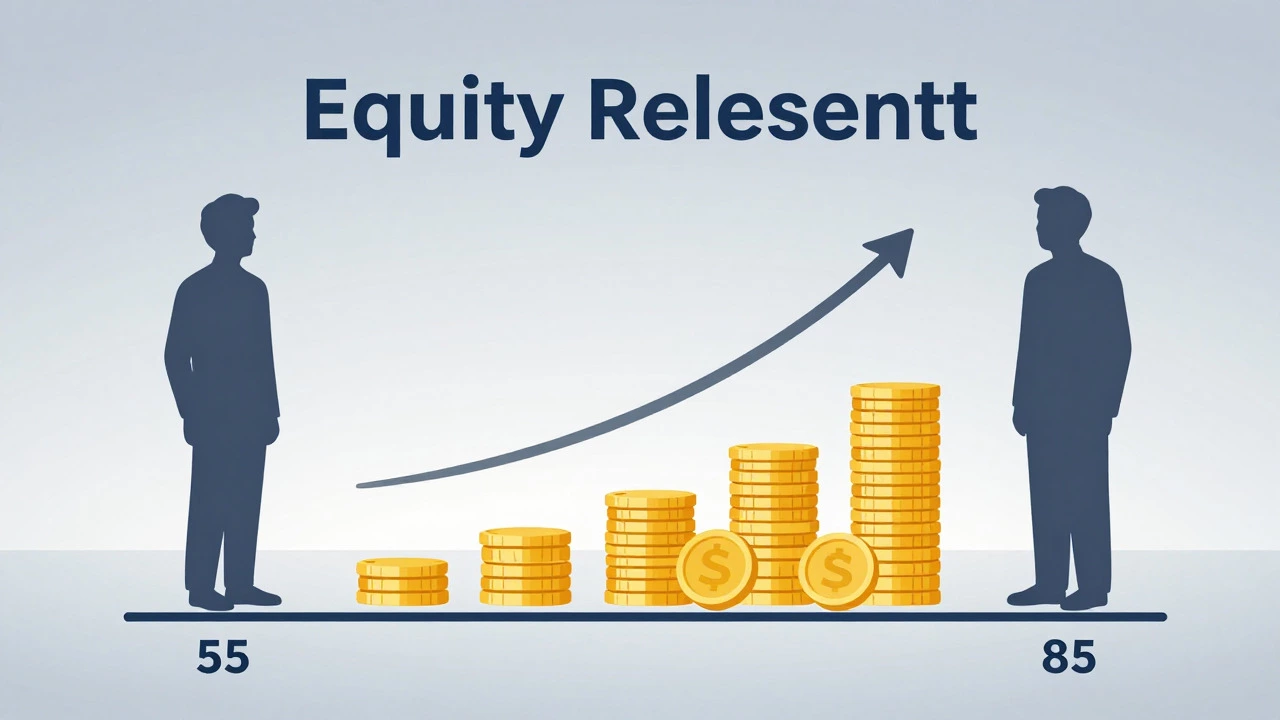
Notice the jump between age 55 and 85. A couple aged 55 might only unlock £80,000 from a £400,000 home. That same couple at age 85 could potentially access £240,000. This is why some people wait until they are older if they don't need the money urgently. However, waiting also means your property value might change, and your health status could affect eligibility.
Property Value and Type Matter
Your home is the security for the loan. Lenders aren't interested in every property equally. They prefer standard brick-and-mortar houses in good condition. If you live in a flat, a bungalow, or a property made of concrete or steel frame, your limit might be lower. Some lenders may even refuse these properties entirely because they are harder to sell if the borrower passes away.
The valuation process is strict. An independent valuer will assess your home. If the market has cooled since you last checked prices, your limit drops. Conversely, if house prices have soared, your potential release amount increases. But remember, the LTV cap still applies. Even if your home doubles in value, you can't suddenly borrow 90% of it unless your age bracket allows it.
Lifetime Mortgages vs. Home Reversion
There are two main types of equity release. The limits work differently for each.
Home reversion plans, which involve selling a share of your property to a provider in exchange for a lump sum or regular income while retaining the right to live there rent-free, have different mechanics. Instead of an LTV, you are selling a percentage of your future estate. Typically, providers will buy between 20% and 60% of your home's value. However, they often discount this share significantly-sometimes paying only 70-80% of the open market value for that share. So, if you sell 50% of a £400,000 home, you might receive £140,000 instead of £200,000. This makes home reversion less popular than lifetime mortgages today, but it can offer higher initial cash injections for very high-value properties.
The No Negative Equity Guarantee
A crucial safety net in the UK is the No Negative Equity Guarantee. This rule, enforced by the Equity Release Council, ensures that you or your estate will never owe more than the value of the home when it is sold. If interest rolls up and theoretically exceeds the house price, the debt is written off. This guarantee protects your heirs from inheriting debt. It also implicitly sets a hard ceiling: your total debt (principal + interest) cannot mathematically exceed the final sale price. This is why lenders are conservative with initial LTVs-they need room for interest to grow without hitting this ceiling.
Impact on Means-Tested Benefits
Here is a hidden limit that many overlook. While the lender says you can borrow £150,000, taking that full amount might disqualify you from certain government benefits. In the UK, if you receive Pension Credit, Attendance Allowance, or Council Tax Reduction, having a large cash lump sum can push your savings above the threshold. For example, if you have more than £10,000 in savings, you lose some Pension Credit. If you have over £16,000, you lose it entirely. So, your "effective" limit might be lower than the lender offers if you want to keep those benefits. Financial advisers often recommend taking smaller amounts over time rather than one massive lump sum to stay under these thresholds.

Interest Rates and Roll-Up Effect
The interest rate on a lifetime mortgage is usually higher than a standard mortgage. As of 2026, rates can range from 5% to 8% depending on the provider and whether the rate is fixed or variable. Since most people don't make monthly repayments, the interest compounds. This "roll-up" effect reduces the available equity over time. If you take the maximum LTV at age 65, you might find that by age 80, half your equity is gone due to interest. This doesn't reduce your immediate cash limit, but it drastically reduces what is left for inheritance. Smart planning involves calculating how much interest will accrue over your expected lifespan.
How to Maximize Your Release Amount
If you need the highest possible limit, consider these strategies:
- Wait until you are older: As shown earlier, age directly boosts LTV.
- Improve your property's value: Simple renovations that increase market value can raise the base figure for the LTV calculation.
- Shop around: Different lenders have different risk appetites. One might offer 40% LTV at age 70, another might offer 45%. Use a whole-of-market adviser.
- Consider partial repayment plans: Some plans allow you to pay up to 10% of the outstanding balance annually without early repayment charges. This keeps the debt lower, preserving more equity for later use or inheritance.
Common Pitfalls to Avoid
Don't assume the advertised maximum is yours. Lenders advertise best-case scenarios for healthy, older applicants with standard homes. Your actual offer will depend on medical underwriting. If you have serious health conditions, some lenders may adjust the terms or reduce the limit because they expect the plan to run longer. Also, beware of fees. Valuation fees, legal fees, and arrangement fees can cost several thousand pounds. These don't reduce your borrowing limit, but they reduce the net cash you walk away with.
Finally, think about the future. Equity release is irreversible in most cases. Once you take the money, you can't easily put it back. If house prices fall, you might feel locked into a bad deal. Always stress-test the numbers: What if I live to 100? What if house prices drop 20%? A good adviser will run these scenarios for you.
Is there a maximum age for equity release?
There is no strict upper age limit, but most lenders require you to be at least 55 years old to apply. Very elderly applicants (e.g., over 90) may face stricter medical checks or limited product choices, but they can still access significant equity due to higher LTV allowances.
Can I release 100% of my home's value?
No. Due to the roll-up of interest and the need to protect against negative equity, you can typically only release between 20% and 60% of your home's value initially. Releasing 100% would leave no buffer for interest accumulation.
Does equity release affect my council tax?
Equity release itself does not change your council tax band, as you still own and live in the home. However, if you use the funds to move to a more expensive area or upgrade your home significantly, a new valuation might trigger a higher council tax band.
What happens if house prices fall after I take equity release?
The No Negative Equity Guarantee protects you. Even if the house sells for less than the outstanding debt, your estate will not owe the difference. The lender absorbs the loss. However, this means your heirs will receive less or nothing from the sale proceeds.
Do I need to pay monthly repayments?
Not necessarily. Most lifetime mortgages allow you to defer payments, meaning interest rolls up. However, making voluntary monthly payments can reduce the total interest charged and preserve more equity for your estate. Some plans also offer annuity-style income payments.