

$50k Debt Payoff Strategy Calculator
Your Debt Profile
Add your debts to see how different strategies affect your payoff plan.
Payoff Analysis
Strategy Comparison
Avalanche
Highest Interest First$0
Total Interest PaidSnowball
Smallest Balance First$0
Total Interest PaidThe Math Behind the Mission
Let’s be brutally honest for a second. Paying off $50,000 of debt in twelve months is not just about willpower; it is a mathematical challenge that requires precision. To clear this balance by next August, you need to make monthly payments of roughly $4,167. That number looks scary on paper, but breaking it down reveals whether this goal is actually within your reach.
If you are earning an average household income, dedicating nearly half of your gross pay to debt repayment might feel impossible. However, if you have multiple income streams or a high disposable income after basic living costs, it becomes a matter of logistics rather than luck. The key isn't just throwing money at the problem; it's ensuring every dollar works as hard as possible against the principal balance.
Many people fail because they underestimate the power of compound interest working against them. If your average interest rate is 15%, you aren't just paying back $50,000; you are likely looking at over $53,000 in total repayments if you stick to a standard amortization schedule. This means your focus must be on reducing the principal quickly while keeping interest accrual to a minimum.
Clean Up Your Financial Picture
Before you write a single check, you need a crystal-clear view of exactly what you owe. List every single debt: credit cards, personal loans, car notes, and any medical bills. For each one, note the outstanding balance, the annual percentage rate (APR), and the minimum monthly payment.
This inventory is crucial because not all debts are created equal. A credit card with a 24% APR is costing you significantly more per month than a student loan at 5%. Without this data, you are flying blind. You might accidentally pay extra toward a low-interest loan while high-interest debt balloons in the background, effectively wasting thousands of dollars.
- Credit Cards: Usually carry the highest interest rates (often 18-29%).
- Personal Loans: Typically range from 6% to 36% depending on credit score.
- Auto Loans: Generally lower, around 4% to 10%.
- Student Loans: Can vary widely but often sit between 3% and 8%.
Once you have this list, calculate your total monthly cash flow. Subtract your absolute essential expenses-rent, utilities, groceries, and transportation-from your net income. Whatever remains is your "war chest" for debt destruction. If that number is less than $4,167, you have two choices: drastically cut spending or increase income. There is no third option.
Choose Your Attack Strategy
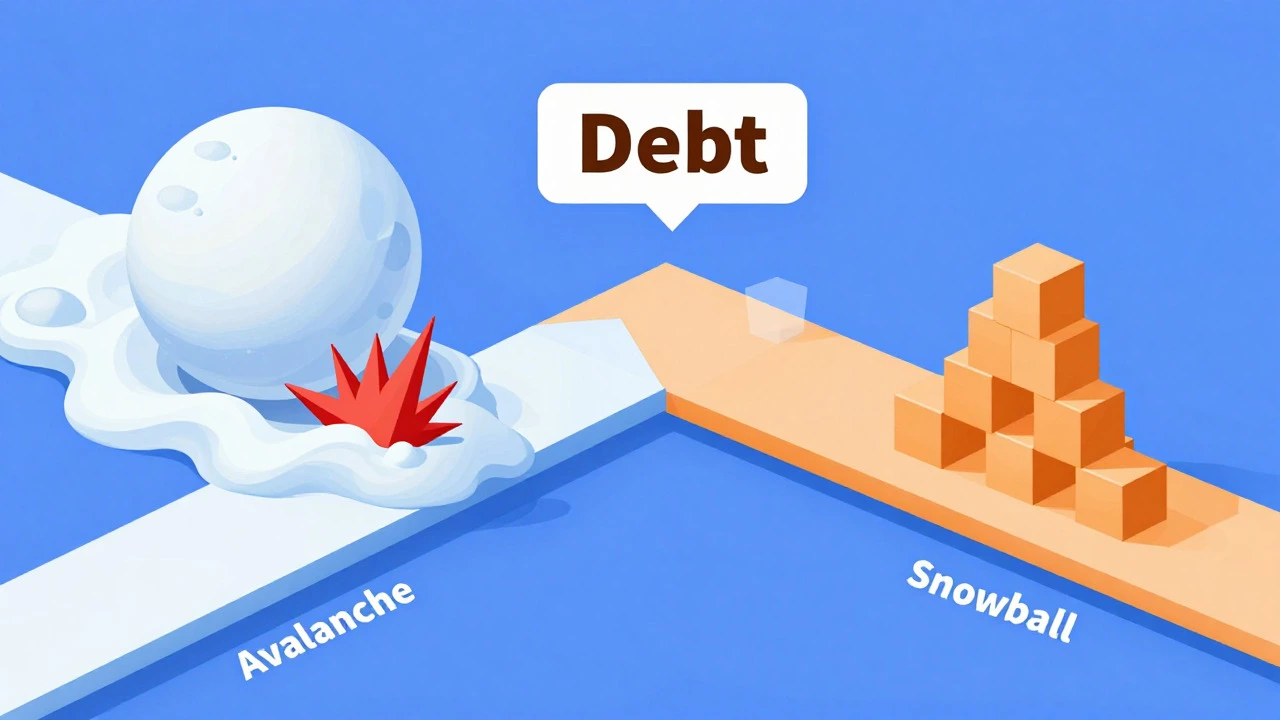
Now comes the tactical decision. How do you allocate those extra dollars? Two main strategies dominate the financial world: the Debt Avalanche and the Debt Snowball. Both work, but they appeal to different psychological profiles.
The Debt Avalanche method targets the debt with the highest interest rate first. You make minimum payments on everything else and throw every spare cent at the highest APR. Mathematically, this saves you the most money over time. If you have a $10,000 credit card at 24% and a $10,000 personal loan at 8%, the avalanche method attacks the credit card first. It’s cold, logical, and efficient.
The Debt Snowball method, popularized by Dave Ramsey, ignores interest rates entirely. Instead, you target the smallest balance first, regardless of the rate. Paying off a $500 credit card bill gives you a quick psychological win. That momentum fuels you to tackle the next smallest debt. While you might pay slightly more in interest, the behavioral boost can keep you motivated when the numbers get tough.
| Feature | Debt Avalanche | Debt Snowball |
|---|---|---|
| Primary Goal | Save maximum interest | Build momentum quickly |
| Best For | Logical thinkers, high-interest debt | People needing motivation, small balances |
| Speed to First Win | Slower (if high-interest debt is large) | Faster (targets smallest balance) |
| Total Interest Paid | Lowest possible | Slightly higher |
For a $50,000 goal in one year, I recommend the Avalanche method if you are disciplined. The interest savings can be substantial. If you find yourself losing steam, switch to the Snowball for a few months to regain confidence, then return to Avalanche.
Slash Expenses Like a Surgeon
To free up that $4,167 monthly, you need to look at your lifestyle with a critical eye. This isn't about misery; it's about temporary sacrifice for long-term freedom. Start with the big three: housing, transportation, and food.
Can you rent out a spare room? In Sydney, short-term rentals or even a long-term roommate can add $1,500 to $2,000 to your monthly budget. Is your car payment eating into your debt payoff? Consider selling your current vehicle and buying a reliable, used car for cash. Eliminating a $600 car payment instantly boosts your debt attack fund.
Food is another major leak. Cooking at home instead of dining out can save hundreds of dollars weekly. Track every purchase for a month using an app like YNAB (You Need A Budget) or Mint. You will likely find subscriptions you forgot about, impulse buys, and convenience fees that add up to significant amounts.
Don't ignore smaller cuts either. Cancel streaming services you don't watch daily. Negotiate your internet and phone bills. Call your providers and ask for retention deals. These small wins accumulate. If you save $200 here and $300 there, you're closing the gap to your $4,167 target without touching your core income.
Increase Your Income Streams
Cutting expenses has a floor-you can only spend so little. Increasing income has no ceiling. To hit a $50k payoff in a year, you likely need both. Look for ways to generate additional revenue outside your primary job.
Freelancing your professional skills is a powerful option. If you are a marketer, writer, coder, or designer, platforms like Upwork or Fiverr can connect you with clients. Even ten hours a week at $50/hour adds $2,000 a month to your debt fund. Driving for Uber or delivering for DoorDash during evenings and weekends can also provide immediate cash flow.
Selling unused items is another quick boost. Go through your closet, garage, and attic. Sell furniture, electronics, and clothes on eBay, Facebook Marketplace, or Poshmark. This isn't sustainable long-term, but a $2,000 windfall from selling old gear can knock out a small credit card balance immediately, giving you a massive psychological boost.
Consider asking for a raise or promotion at your current job. Prepare a case based on your achievements and market value. Alternatively, look for a higher-paying role in your industry. A $10,000 salary increase translates to roughly $700 more per month after tax, which goes straight to your highest-interest debt.

Negotiate Interest Rates and Terms
Before you start paying, try to lower the cost of borrowing. Call your credit card issuers and ask for a lower APR. Mention that you are a loyal customer and that you are actively trying to pay off your balance. Many companies have retention teams willing to drop rates to keep you from leaving.
If negotiation fails, consider a balance transfer credit card with a 0% introductory APR. This allows you to move high-interest debt to a card with no interest for 12-18 months. Just be aware of the transfer fee, usually 3-5%, and ensure you can pay off the balance before the promotional period ends. Missing a payment can void the deal and trigger penalty rates.
For larger debts, a personal consolidation loan might make sense. If you can secure a loan at 8% to pay off credit cards at 20%, you save money immediately. Ensure the new loan has no origination fees and that you commit to not running up new credit card debt. Consolidation simplifies payments but doesn't fix bad habits.
Stay Motivated and Avoid Pitfalls
The hardest part of paying off $50,000 in a year is staying consistent. Life will throw curveballs: car repairs, medical bills, family emergencies. Build a small emergency fund, even if it's just $1,000, to prevent these setbacks from derailing your progress. Keep this fund separate from your debt payments.
Avoid the temptation to use credit cards for daily expenses. Switch to debit or cash. Hide your credit cards in a drawer. Every time you resist a purchase, visualize the debt shrinking. Use apps that show your progress visually. Seeing the balance drop from $50,000 to $40,000 is incredibly rewarding.
Surround yourself with support. Tell friends and family about your goal. Their encouragement can help you stay on track. Join online communities focused on debt freedom. Sharing struggles and victories with others who understand the journey provides invaluable emotional support.
Remember, this is a marathon, not a sprint. There will be days when you want to quit. On those days, remind yourself why you started. Financial freedom is worth the temporary discomfort. Stay focused, adjust your plan as needed, and keep pushing forward. You can do this.
Is it realistic to pay off $50,000 in debt in one year?
Yes, it is realistic if you have a high disposable income or can significantly increase your earnings. You need to pay approximately $4,167 per month. This requires strict budgeting, potential lifestyle changes, and possibly additional income streams. It is challenging but achievable for many households.
What is the best method to pay off multiple debts quickly?
The Debt Avalanche method is mathematically superior as it targets the highest interest rates first, saving you the most money. However, the Debt Snowball method may be better for motivation if you need quick wins to stay committed. Choose based on your personality and discipline level.
Should I use a balance transfer card to pay off debt?
A balance transfer card with 0% APR can be very effective if you can pay off the transferred balance within the promotional period (usually 12-18 months). Be mindful of transfer fees (3-5%) and avoid making new purchases on the card. It works best for disciplined payers.
How much should I save for emergencies while paying off debt?
Financial experts recommend having at least $1,000 to $2,000 in an emergency fund before aggressively attacking debt. This prevents unexpected expenses from forcing you to use credit cards again. Keep this fund easily accessible but separate from your daily spending accounts.
What if I fall behind on my debt payoff plan?
Don't panic. Assess what went wrong and adjust your budget. Cut more expenses or find ways to earn extra income temporarily. Communicate with creditors if you are struggling to make payments; they may offer hardship programs. Consistency is key, so get back on track as soon as possible.