

Homeowners Insurance Refund Calculator
Enter your details to see how much you might get back.
Remember: Always secure new coverage before canceling to avoid gaps.
You paid for a full year of homeowners insurance, but life changed. Maybe you sold your house, refinanced with a new lender, or just found a better deal. Now you’re staring at that policy document wondering: "Do I get my money back?" The short answer is yes, usually. But the amount hitting your bank account might be less than you think, and how you cancel matters more than you realize.
Most people assume insurance works like a subscription you can pause anytime. It doesn’t. Insurance premiums are paid upfront for coverage over time. When you cancel early, you’re asking for a return of the "unearned premium"-the portion of the policy period that hasn’t happened yet. Whether you get 100% of that back depends on why you canceled and which method your insurer uses to calculate the refund.
The Two Ways Insurers Calculate Your Refund
Not all refunds are created equal. There are two primary methods insurers use to determine how much cash goes back into your pocket. Understanding the difference can save you hundreds of dollars.
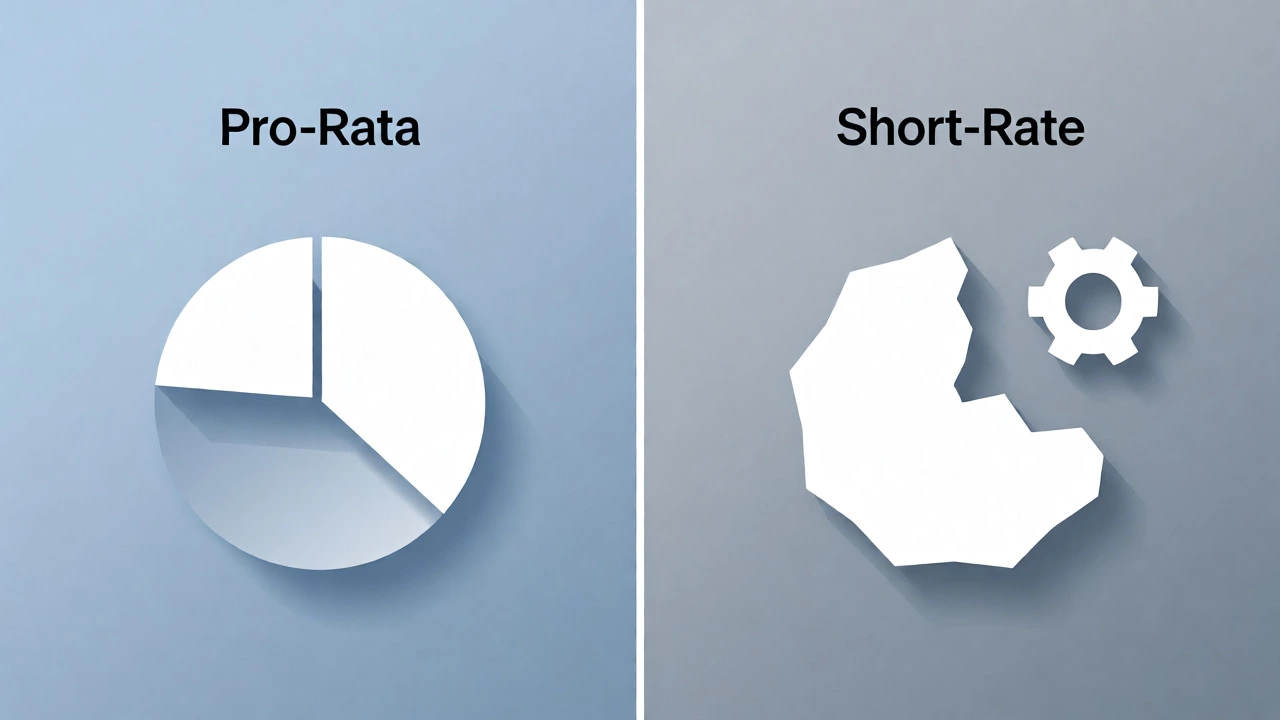
The first method is called pro-rata cancellation. This is the fair-and-square approach. If you paid $1,200 for a 12-month policy and cancel after exactly six months, you get back half of your money ($600). The insurer simply divides your annual premium by the number of days in the term and multiplies it by the unused days. No penalties, no games. This method typically applies when:
- You sell your home and transfer ownership.
- Your mortgage lender requires a different insurer.
- The property is destroyed (total loss).
- You move out permanently and switch to renters insurance.
The second method is short-rate cancellation. This one stings. Here, the insurer charges a penalty fee for the inconvenience of canceling mid-term. Instead of returning the exact unused portion, they keep a small percentage as an administrative cost. For example, if you cancel halfway through, you might only get back 45-48% instead of 50%. Short-rate cancellations usually happen when:
- You decide to switch insurers because you found a cheaper quote.
- You change your mind about coverage levels.
- You cancel without providing a specific reason related to the property itself.
| Cancellation Type | Reason Example | Refund Calculation | Who Benefits? |
|---|---|---|---|
| Pro-Rata | Sold home / Lender switch | Exact unused days value | Policyholder |
| Short-Rate | Found cheaper policy | Unused days minus penalty fee | Insurance Company |
Timing Is Everything: Don’t Cancel Too Early
Here’s a mistake that costs homeowners real money: canceling the old policy before the new one starts. If you cancel your current insurance policy on Monday, but your new coverage doesn’t kick in until Wednesday, you have a gap. During those two days, your home is uninsured. If a pipe bursts or a storm hits, you pay out of pocket.
Worse, some insurers will not issue a refund if there’s a coverage gap. They argue that since you weren’t continuously covered, they aren’t obligated to return the premium in the same way. Always align your effective dates perfectly. Ask your new insurer to start coverage on the exact day your old policy ends. Most modern carriers allow this seamless transition.
If you’re selling your home, timing is even trickier. You need coverage until the closing date. Once the deed transfers, you no longer have an insurable interest in the property. That means your policy effectively ends. In this scenario, you almost always qualify for a pro-rata refund. Provide your insurer with the settlement statement from your lawyer or title company as proof. Without this document, they might default to a short-rate calculation, costing you extra fees.
What About Monthly Payments?
If you pay your premium monthly rather than annually, the refund logic shifts slightly. You won’t get a big check for "unused months." Instead, you stop paying future installments. However, if you’ve already paid ahead for a month or two, you should receive a refund for those specific prepaid periods.
Check your payment schedule carefully. Some lenders bundle insurance into your mortgage escrow account. If you cancel the policy, your mortgage servicer needs to know immediately. Otherwise, they’ll keep pulling money from your escrow for insurance that no longer exists. This leads to a messy reconciliation process later. Notify both your insurer and your mortgage provider simultaneously to keep your finances clean.
Administrative Fees and Hidden Costs
Even with a pro-rata refund, don’t expect every cent back. Many insurers charge a flat administrative fee for processing cancellations. This fee varies wildly by carrier and state regulations. In Australia, for instance, fees might range from $20 to $50. In the US, it could be higher depending on the state.
Read your policy’s "Cancellation" clause. It’s usually buried near the end of the contract. Look for terms like "cancellation fee," "administrative charge," or "processing fee." If you’re switching to a competitor, factor this fee into your savings calculation. Sometimes, the "cheaper" new policy isn’t actually cheaper once you account for the cancellation penalty on the old one.
Step-by-Step: How to Get Your Money Back
Don’t just call customer service and hope for the best. Follow these steps to ensure you maximize your refund and minimize delays.
- Secure New Coverage First: Never cancel until your replacement policy is active. Have the new policy number ready.
- Gather Documentation: Collect your current policy declarations page, proof of sale (if applicable), and the new policy start date.
- Contact Your Insurer: Call or log in online. Request cancellation in writing if possible. Email trails are gold mines during disputes.
- Specify the Effective Date: Be precise. "Cancel effective November 30, 2026, at 12:01 AM." Vague requests lead to errors.
- Ask for the Calculation Method: Explicitly ask, "Will this be calculated pro-rata or short-rate?" If they say short-rate, ask if you can provide proof of sale or lender requirement to switch to pro-rata.
- Confirm the Refund Amount: Get a verbal estimate. Then ask them to email a breakdown showing total premium paid, days used, daily rate, and total refund.
- Update Payment Methods: Ensure your credit card or bank account details are correct for the direct deposit or check mailing.

Special Scenarios That Affect Refunds
Life throws curveballs that complicate standard cancellation rules. Here are three common situations where the refund process changes.
Claim History Matters: If you filed a claim recently, your insurer might refuse a pro-rata refund. They may argue that because you utilized their services (by filing a claim), you forfeited the right to a penalty-free exit. This is less common now but still happens with smaller, non-standard carriers. Check your state or local consumer protection laws; many jurisdictions prohibit penalizing cancellations solely due to claims history.
Downsizing or Moving: If you’re moving from a detached house to an apartment, you’re technically changing your insurance type, not just canceling. You’ll likely close the homeowners policy and open a renters policy. These are separate products. You’ll get a refund on the homeowners side and pay separately for the renters side. Don’t expect the agents to automatically offset the costs.
Bankruptcy or Foreclosure: If you lose your home to foreclosure, your insurance obligation ends when the bank takes possession. However, the timeline can be murky. Keep records of all communications with the bank and your insurer. If the insurer cancels the policy themselves due to non-payment, you generally do not get a refund for the period after the cancellation notice was sent, even if you had paid in advance.
When You Won’t Get a Refund
There are rare cases where you walk away empty-handed. If you cancel within the "free look" period (usually 10-15 days after signing up), you get a full refund. But if you miss that window and cancel without cause, you might face steep short-rate penalties. Additionally, if your policy has been in force for less than 30 days, some insurers retain the entire first month’s premium regardless of when you cancel.
Also, watch out for "minimum earned premium" clauses. Some policies state that the insurer keeps a minimum amount (e.g., 10% of the annual premium) no matter how early you cancel. This protects them against churn. If you bought a policy and realized five days later it was wrong, you might still lose that 10% chunk.
How long does it take to receive a homeowners insurance refund?
Typically, refunds arrive within 7 to 14 business days after the cancellation is processed. If you paid via credit card, the credit may appear faster, often within 3-5 days. Checks mailed by traditional insurers can take up to three weeks. Delays often occur if the insurer lacks your updated banking information or if there are outstanding fees to deduct.
Can I cancel homeowners insurance if I haven't made any claims?
Yes, having zero claims makes it easier to negotiate a pro-rata refund. Since you haven't used the insurer's resources to process a claim, they have less justification for charging a short-rate penalty. Always highlight your claim-free status when requesting cancellation to potentially avoid administrative fees.
Does canceling insurance affect my credit score?
No, canceling an insurance policy directly does not impact your credit score. Insurance companies do not report timely payments or cancellations to credit bureaus like Equifax or Experian. However, if you cancel because you couldn't afford the premium and missed payments, those late marks might hurt your score, but the act of cancellation itself is neutral.
What if my mortgage lender forces me to change insurers?
If your lender requires a specific insurer or denies your current policy, you are entitled to a pro-rata refund. Provide the letter from your lender stating the requirement. This is considered a "forced cancellation," and most reputable insurers waive short-rate penalties in this scenario to maintain good relationships with lending partners.
Is there a tax implication for receiving an insurance refund?
Generally, no. Personal homeowners insurance premiums are not tax-deductible for primary residences, so the refund is not taxable income. However, if you claimed the premiums as a business expense (for a home office or rental property), you may need to adjust your previous tax filings to reflect the reduced expense. Consult a tax professional for your specific situation.