

Passive Income Capital Calculator
Your Goals & Scenario
Enter your details and click calculate to see how much capital you need.
Imagine waking up every month to see exactly $3,000 hit your bank account. No boss calling, no client emails, just pure cash flow from your assets. It sounds like a dream, but it’s a math problem you can solve today. The question isn’t whether you *can* do it; it’s how much capital you need to start the engine.
The short answer? You’re looking at anywhere from $360,000 to $1.2 million, depending on how aggressive or conservative you want to be with your money. But those numbers aren’t set in stone. They shift based on market conditions, your risk tolerance, and the specific vehicles you choose to park your cash in.
The Math Behind the Magic: Understanding Yield Rates
To figure out your target number, we need to talk about yield. Yield is the annual return an investment generates relative to its cost. If you buy a bond that pays $50 a year for every $1,000 you invest, that’s a 5% yield. To get $3,000 a month, you need $36,000 a year. Simple division tells us the rest.
| Investment Strategy | Average Annual Yield | Capital Needed | Risk Level |
|---|---|---|---|
| High-Yield Savings Accounts | 4.5% | $800,000 | Very Low |
| Treasury Bonds | 4.0% | $900,000 | Low |
| Dividend Growth Stocks | 3.0% - 3.5% | $1,028,000 - $1,200,000 | Medium |
| REITs (Real Estate Investment Trusts) | 5.0% - 6.0% | $600,000 - $720,000 | Medium-High |
| Private Lending / Notes | 8.0% - 10.0% | $360,000 - $450,000 | High |
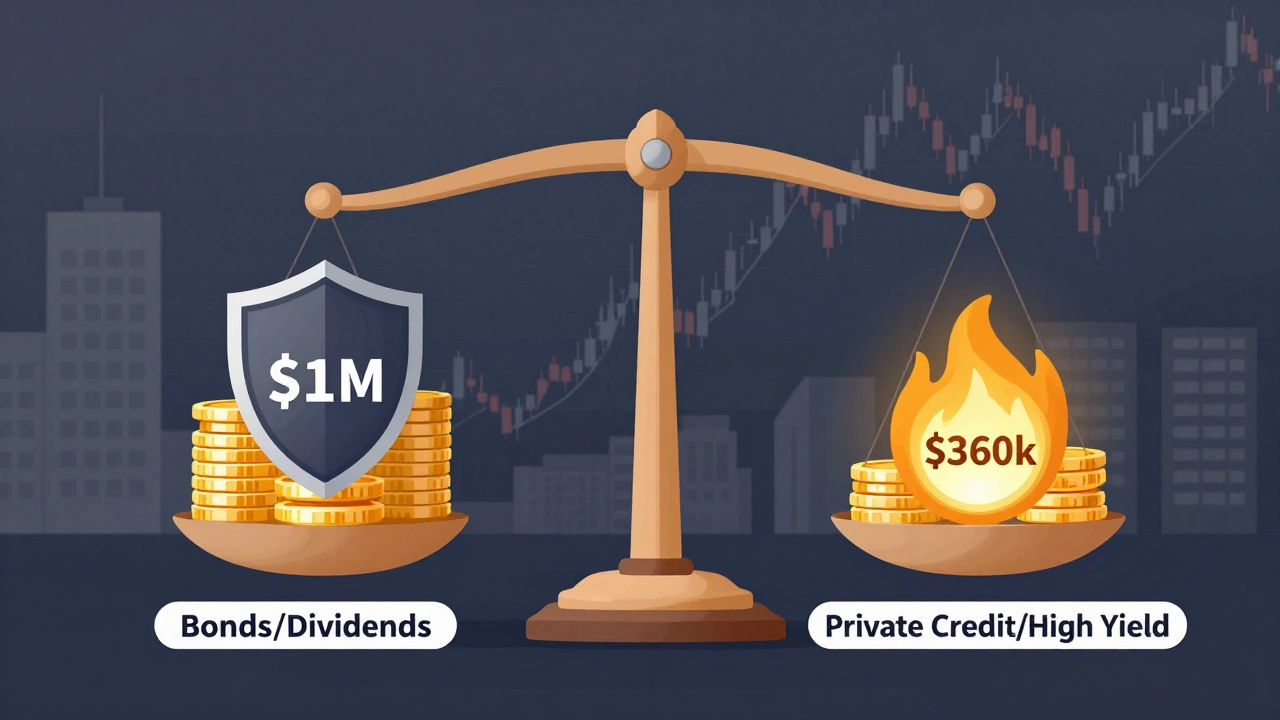
See the difference? If you play it safe with government bonds, you need nearly a million dollars. If you’re willing to take on more risk with private lending, you might only need half that amount. There is no free lunch in finance. Higher yields always come with higher risks of losing principal.
Option 1: The Stock Market Route (Dividends & ETFs)
Most people think of the stock market when they hear "investing." And for good reason-it’s liquid, accessible, and requires zero maintenance once you set it up. But not all stocks are created equal when it comes to monthly income.
You have two main paths here: Dividend Aristocrats and Exchange-Traded Funds (ETFs).
Dividend Aristocrats are companies that have increased their payouts for 25+ consecutive years. Think of household names like Johnson & Johnson or Coca-Cola. They are stable, boring, and reliable. However, their yields are often low, hovering around 2-3%. To get $36,000 a year from a 3% yield, you need $1.2 million invested. That’s a high bar, but the downside is minimal. These stocks rarely crash hard, and they protect your purchasing power against inflation over time.
On the other hand, ETFs like Schwab U.S. Dividend Equity ETF (SCHD) or Vanguard High Dividend Yield ETF (VYM) offer diversification. Instead of betting on one company, you own a slice of hundreds. Their yields typically range from 3% to 4%. This lowers your capital requirement to roughly $900,000-$1.2 million. The beauty of ETFs is that if one company stops paying dividends, the fund adjusts automatically. You don’t have to do anything.
Option 2: Real Estate Without the Headaches (REITs)
Buying physical rental properties is a classic way to generate cash flow. But let’s be real: fixing toilets at 2 AM isn’t passive income. It’s a second job. Enter Real Estate Investment Trusts (REITs).
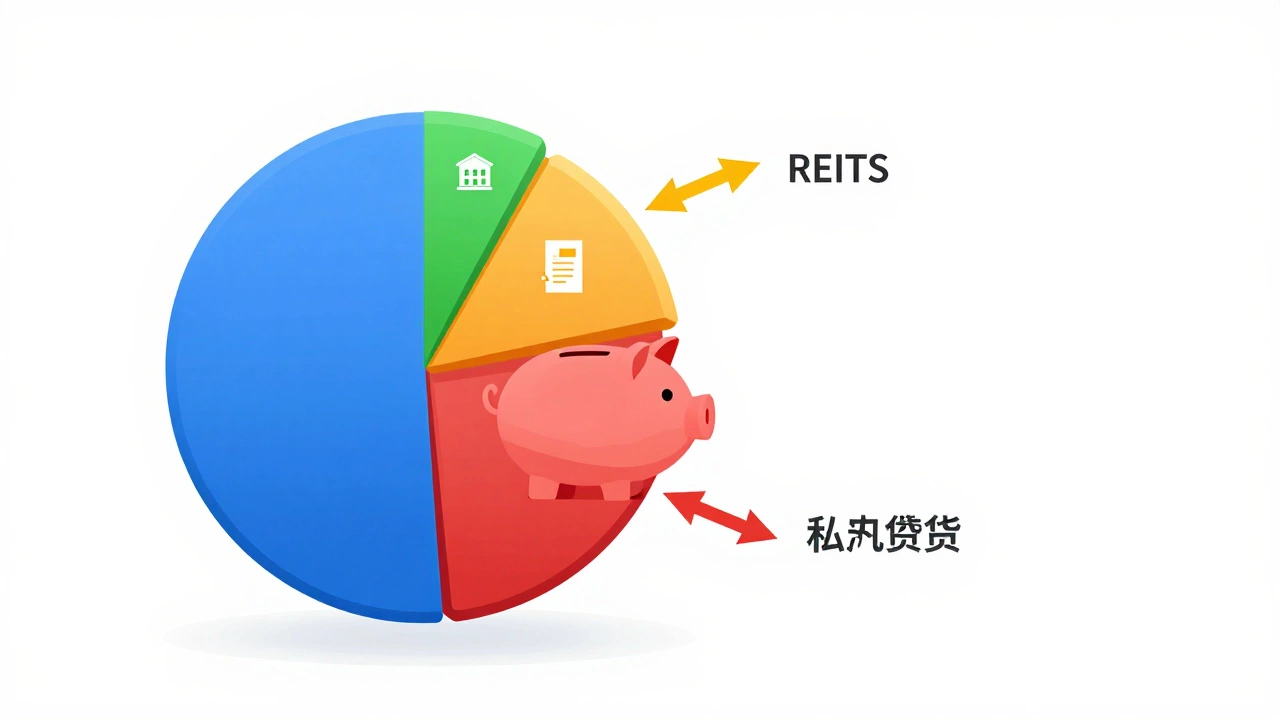
REITs are companies that own or finance income-producing real estate. By law, they must distribute at least 90% of their taxable income to shareholders as dividends. This makes them incredibly lucrative for income seekers. Public REITs trade on major exchanges just like stocks, so you can buy shares of Realty Income (O) or Simon Property Group (SPG) with a few clicks.
Yields on REITs often sit between 5% and 7%. If you aim for a 6% average yield, you’d need about $600,000 to generate your $36,000 annual target. That’s significantly less than the stock market route. However, REITs are sensitive to interest rates. When the Federal Reserve raises rates, borrowing costs go up, which can squeeze REIT profits and drop their share prices. They also tend to be more volatile than broad market index funds.
Option 3: Fixed Income and Bonds
If the thought of your portfolio dropping 20% in a bear market keeps you up at night, fixed income is your friend. U.S. Treasury Bonds are backed by the full faith and credit of the United States government. They are virtually risk-free regarding default.
In mid-2026, Treasury yields have stabilized around 4-5% for intermediate-term notes. Let’s assume a 4.5% yield. To get $36,000 a year, you need $800,000. Yes, that’s a lot of capital upfront. But consider this: you know exactly what you’ll get every six months. There’s no guessing game. Your principal is safe. Inflation is the enemy here, though. If inflation runs at 3%, your real return is only 1.5%. You’re preserving wealth, not growing it aggressively.
Corporate bonds offer slightly higher yields, often 5-6%, because they carry more risk. Companies like Apple or Microsoft issue debt, and their bonds are considered very safe. Junk bonds (high-yield bonds) can pay 7-8%, but if the economy tanks, those issuers might default. Stick to investment-grade corporate bonds if you want a balance between safety and yield.
Option 4: Private Credit and Peer-to-Peer Lending
This is where things get spicy. Private credit involves lending money directly to businesses or individuals, bypassing traditional banks. Platforms like LendingClub or Prosper allow you to act as the bank. Yields can range from 8% to 12%.
At a 10% yield, you only need $360,000 to hit your $3,000/month goal. That’s a huge reduction in required capital. But look closely at the risk. If the borrower defaults, you lose your money. During economic downturns, default rates spike. Diversification is key-you shouldn’t lend large chunks to single borrowers. Spread your $360k across thousands of small loans to mitigate individual default risk. This strategy requires active management and a stomach for volatility.
The Hidden Killer: Inflation and Taxes
Let’s talk about the two things that will eat your $3,000 alive: taxes and inflation.
First, taxes. Most of these investments generate taxable income. Dividends, interest, and REIT distributions are taxed as ordinary income or qualified dividends, depending on the source. If you’re in the 24% tax bracket, your $36,000 gross income becomes $27,360 net. To actually take home $3,000 after taxes, you need to gross $3,947 per month. That bumps your required capital up by another 10-15%.
Second, inflation. $3,000 buys a lot today. In ten years, it might only buy $2,200 worth of goods. If your investments only yield 4% and inflation is 3%, your purchasing power grows by just 1%. Over decades, this erosion adds up. This is why many investors prefer growth-oriented assets (like total market index funds) and sell off portions of their holdings to create income, rather than relying solely on yield. Selling appreciated stock can be more tax-efficient than receiving taxable dividends.
Building the Portfolio: A Step-by-Step Approach
You probably don’t have $1 million sitting in your checking account. So how do you get there? You build it brick by brick.
- Maximize Tax-Advantaged Accounts: Start with your 401(k) and IRA. Contributions reduce your taxable income now, letting your money grow faster. Use these accounts for high-yield, tax-inefficient assets like bonds and REITs.
- Automate Contributions: Set up automatic transfers from your paycheck to your investment accounts. Consistency beats timing the market. Even $500 a month adds up to over $180,000 in 20 years without any growth.
- Diversify Across Asset Classes: Don’t put all your eggs in one basket. A balanced mix might include 40% dividend stocks, 30% bonds, 20% REITs, and 10% alternatives like private credit or commodities.
- Reinvest Early On: In the beginning, don’t spend the dividends. Reinvest them to buy more shares. Compound interest is the eighth wonder of the world. Once your portfolio reaches critical mass (say, $500k), start taking the cash flow.
- Review and Rebalance Annually: Markets change. If stocks surge, they might become too large a portion of your portfolio. Sell some winners and buy losers to maintain your target allocation. This forces you to buy low and sell high systematically.
Common Pitfalls to Avoid
Chasing yield is the fastest way to lose money. You’ll see ads for "15% guaranteed returns" or "crypto staking bonuses." Run away. If it sounds too good to be true, it is. High yields usually signal high risk or fraud.
Another mistake is ignoring fees. Expense ratios on ETFs and mutual funds can seem small-0.1% or 0.5%-but they compound against you over time. On a $1 million portfolio, a 1% fee is $10,000 a year gone. Choose low-cost index funds whenever possible.
Finally, don’t neglect liquidity. Cash is king during emergencies. Keep 3-6 months of expenses in a High-Yield Savings Account (HYSA). Don’t lock all your money into illiquid assets like real estate or long-term bonds if you might need access to it soon.
Can I really make $3,000 a month with only $100,000 invested?
Not sustainably through passive investing alone. To generate $36,000 a year from $100,000, you’d need a 36% annual return, which is impossible without extreme gambling. Professional investors aim for 7-10% annually. With $100k, you’re looking at roughly $700-$1,000 per month in passive income. To reach $3,000, you’d need to add significant new capital each year or find ways to increase your active income.
Is it better to use dividends or sell stocks for income?
It depends on your tax situation and goals. Dividends provide steady cash flow without selling assets, which preserves your principal. However, they are taxed annually. Selling a portion of a growth portfolio (like a total market index fund) allows you to control when you realize gains, potentially deferring taxes. Many financial advisors recommend a hybrid approach: use dividends for baseline income and sell assets for supplemental needs.
How does inflation affect my $3,000 monthly goal?
Inflation erodes purchasing power. If inflation averages 3% per year, $3,000 today will have the buying power of roughly $2,200 in ten years. To combat this, your investments need to grow faster than inflation. This means incorporating growth assets like stocks into your portfolio, even if you’re focused on income. Pure fixed-income strategies may fail to keep up with rising living costs over the long term.
What are the safest investments for generating monthly income?
The safest options are U.S. Treasury Bills and Certificates of Deposit (CDs). They are insured by the government or FDIC, respectively. However, their yields are lower, meaning you need more capital to hit your $3,000 target. For slightly more risk but higher safety than stocks, investment-grade corporate bonds are a solid choice.
Do I need a financial advisor to achieve this?
No, but it helps. DIY investors can build a robust portfolio using low-cost ETFs and automated tools. However, a fee-only fiduciary advisor can help optimize for taxes, ensure proper asset allocation, and provide behavioral coaching during market crashes. If your portfolio exceeds $500,000, the value of professional advice often outweighs the cost.