
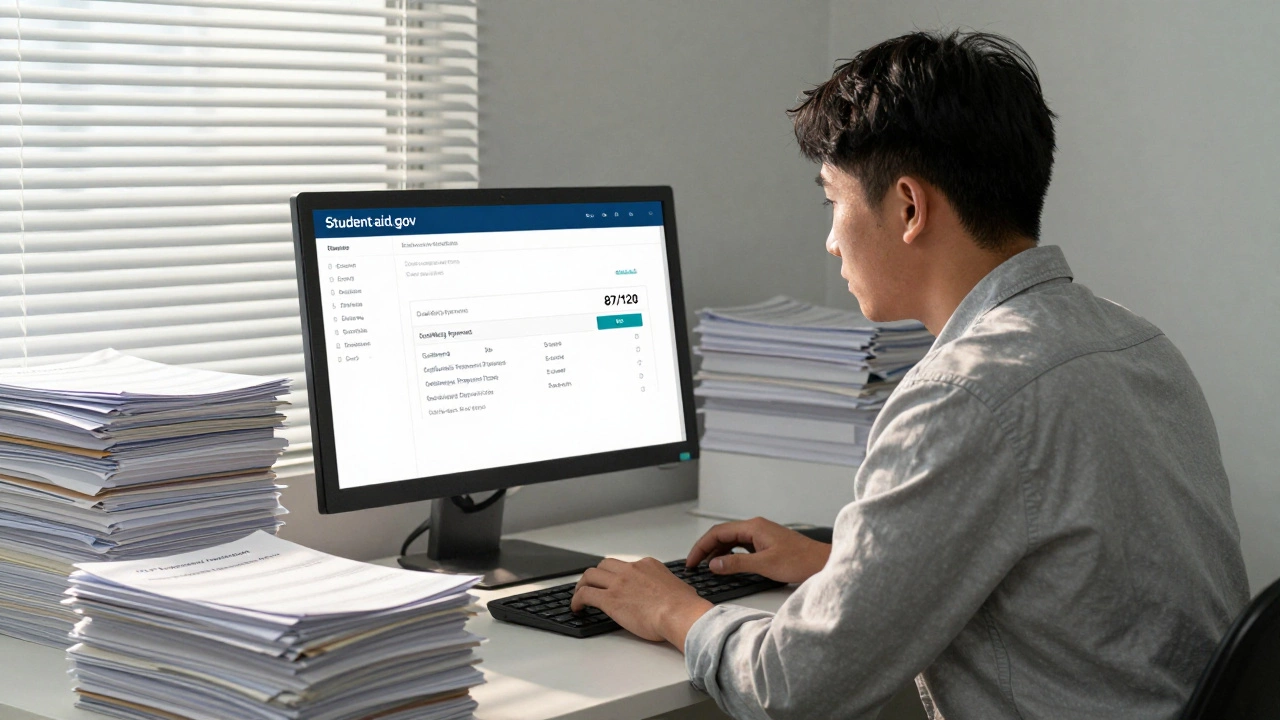
PSLF Progress Calculator
Track Your PSLF Progress
See how many qualifying payments you've made toward 120 total required for forgiveness
Important: You must have Direct Loans and be on an income-driven repayment plan to qualify for PSLF.
If you’re carrying student debt and wondering if it’s possible to wipe it out completely, you’re not alone. Thousands of people in the U.S. have had their loans forgiven - not through luck, but by following specific, government-backed rules. The truth? There’s no magic trick. But there are clear, legal paths to 100% student loan forgiveness if you meet the requirements. Most people fail because they don’t know the rules, miss deadlines, or misunderstand what counts. This isn’t about hoping for a bailout. It’s about playing the system the right way.
Public Service Loan Forgiveness (PSLF) - The Most Common Path
PSLF is the most well-known route to full loan forgiveness. It’s designed for people working in public service jobs - government, nonprofits, schools, hospitals, and some religious organizations. If you qualify, your remaining loan balance is wiped clean after 120 qualifying monthly payments (that’s 10 years).
Here’s how it actually works:
- You must have Direct Loans. If you have older FFEL or Perkins loans, you need to consolidate them into a Direct Consolidation Loan first.
- You must be on an income-driven repayment plan (like IBR, PAYE, or REPAYE). Standard 10-year plans don’t count.
- You must work full-time (at least 30 hours per week) for a qualifying employer. That includes public schools, state or local government agencies, 501(c)(3) nonprofits, and some other nonprofits that serve the public.
- You must make 120 on-time, full monthly payments after October 1, 2007.
Here’s the catch: the Department of Education approved fewer than 40% of PSLF applications before 2021. Why? People filed paperwork late, didn’t submit Employment Certification Forms annually, or used the wrong repayment plan. Since 2021, the Department has run temporary waivers that count past payments even if they were made under the wrong plan or with the wrong servicer. That window closed in October 2022, but if you’re still on track, you can still apply.
Check your progress: log into studentaid.gov and look for your PSLF count. If it says "0," you’re not on the right track. Fix it now.
Income-Driven Repayment Forgiveness - After 20 or 25 Years
Even if you don’t work in public service, you can still get your loans forgiven - but it takes longer. Under income-driven repayment (IDR) plans, your monthly payment is based on your income and family size. After 20 or 25 years of payments, whatever’s left is forgiven.
Here’s the breakdown:
- For new borrowers on or after July 1, 2014: Forgiveness after 20 years.
- For borrowers before that date: Forgiveness after 25 years.
- Plans include: PAYE, REPAYE, IBR, and ICR.
This isn’t free money. The forgiven amount is treated as taxable income by the IRS. So if you have $50,000 left when you qualify, you could owe $10,000-$15,000 in taxes. Plan for it. Set aside money each year.
Some borrowers get surprised when they hit the 20-year mark and find out their payments were too low to cover interest. That’s normal - your balance might grow at first. But as long as you’re on the plan and making payments, you’re on track.
Disability Discharge - If You’re Totally and Permanently Disabled
If you’re unable to work due to a total and permanent disability, you may qualify for a full discharge of your federal student loans. This applies to Direct Loans, FFEL, and Perkins Loans.
To qualify, you need to prove one of these:
- You receive Social Security Disability Insurance (SSDI) or Supplemental Security Income (SSI), and your next review is at least 5-7 years out.
- A doctor certifies you’re permanently disabled and unlikely to recover.
- You’re a veteran with a 100% disability rating from the VA.
Once approved, your loans are canceled. You won’t owe taxes on the forgiven amount. But there’s a catch: you’ll enter a three-year monitoring period. If you earn above a certain income threshold during that time, the discharge can be reversed. That’s why it’s critical to avoid full-time work during those years.
Teacher Loan Forgiveness - For Educators
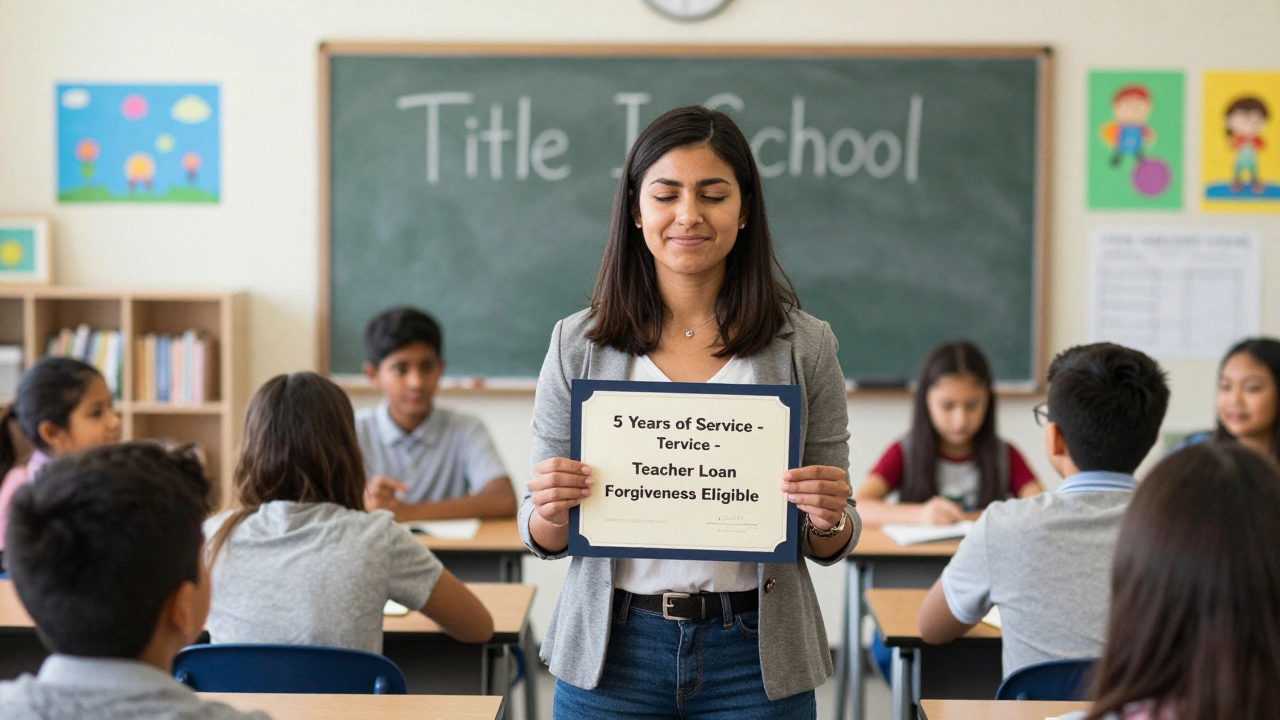
If you teach full-time for five consecutive years in a low-income school or educational service agency, you may qualify for up to $17,500 in forgiveness on Direct or FFEL loans.
It’s not 100% unless your balance is $17,500 or less. But if you’re a high school math or science teacher in a Title I school, this can wipe out most of your debt. You must submit the Teacher Loan Forgiveness Application after your fifth year.
Important: You can’t combine this with PSLF for the same period. Pick one path. If you work in public education and also qualify for PSLF, PSLF usually gives you more.
Borrower Defense to Repayment - If Your School Lied to You
If your school misled you - lied about job placement rates, accreditation, or transfer credits - you might qualify for full loan discharge. This applies to students who attended schools that closed, like Corinthian Colleges or ITT Tech.
Thousands of people have already received forgiveness under this program. The Department of Education approved over $11 billion in claims as of 2024. You don’t need a lawyer. Just file a Borrower Defense application on studentaid.gov.
You’ll need to show evidence: emails, brochures, transcripts, or ads that prove the school made false promises. The more documentation, the better.
Closed School Discharge - If Your School Shut Down
If your school closed while you were enrolled or within 120 days after you withdrew, you may qualify for a full discharge. This applies to federal loans only.
You don’t have to apply if you were automatically eligible - the Department of Education sometimes reaches out. But if you haven’t heard anything, go to studentaid.gov and search for "closed school discharge." Fill out the form. You’ll need your school’s name, dates of attendance, and loan details.
Important: If you transferred credits to another school, you may not qualify. The discharge only works if you didn’t continue your education elsewhere.
What Doesn’t Work
There are scams everywhere. You’ll see ads promising "instant forgiveness" for $499. Ignore them. No one can guarantee forgiveness outside the official programs. The government doesn’t charge fees for these applications.
Also, private student loans don’t qualify for any of these programs. Only federal loans - Direct, FFEL, Perkins - are eligible. If you have private loans, you’re stuck with your lender’s terms.
And no, bankruptcy won’t erase student loans. It’s extremely rare to get them discharged in court. You’d need to prove extreme hardship - like a permanent disability or chronic illness that prevents you from ever working again.
How to Start Today
Step one: Find out what kind of loans you have. Go to studentaid.gov and log in. Look at your loan types. If you see FFEL or Perkins loans, you’ll need to consolidate them into Direct Loans to qualify for PSLF or IDR forgiveness.
Step two: Confirm your repayment plan. If you’re on the standard 10-year plan, switch to an income-driven plan. Your payments will drop, and you’ll start counting toward forgiveness.
Step three: If you work in public service, submit your Employment Certification Form every year. Even if you think you’re doing fine, do it. Miss one, and you might lose credit for that year.
Step four: Keep records. Save every payment receipt, pay stub, and employer letter. You might need them in 10 years.
What Happens After Forgiveness?
Once your loans are forgiven, you’ll get a letter from your loan servicer. Your account will be marked as "closed, forgiven." You won’t owe anything else.
But if you’re forgiven under an IDR plan, you’ll get a 1099-C form from the IRS. That means the forgiven amount is taxable income. You’ll need to pay taxes on it. If you’re forgiven under PSLF, Borrower Defense, or Disability Discharge, you won’t owe taxes.
Plan ahead. If you expect to owe taxes, start saving $50-$100 a month now. That way, you won’t be hit with a huge bill when the time comes.
Final Reality Check
Getting 100% student loan forgiveness isn’t easy. It takes discipline, paperwork, and time. But it’s real. People do it every day. The difference between those who succeed and those who don’t? They started early, stayed organized, and didn’t wait for someone else to fix it for them.
If you’re serious about wiping out your debt, don’t wait for a new policy. Use the tools that already exist. Your future self will thank you.
Can I get student loan forgiveness if I have private loans?
No. Only federal student loans - like Direct Loans, FFEL, and Perkins Loans - qualify for government forgiveness programs. Private loans from banks or credit unions don’t have any forgiveness options. Your only options are refinancing, income-based repayment plans offered by the lender (if any), or paying them off manually.
Do I have to pay taxes on forgiven student loans?
It depends. If your loans are forgiven through Public Service Loan Forgiveness, Borrower Defense, or Total and Permanent Disability Discharge, you won’t owe federal taxes. But if you’re forgiven under an income-driven repayment plan after 20 or 25 years, the forgiven amount counts as taxable income. You’ll get a 1099-C form and need to pay income tax on it. Some states also tax it. Plan ahead.
How do I know if my employer qualifies for PSLF?
Your employer must be a government agency or a 501(c)(3) nonprofit. Public schools, state hospitals, and city agencies qualify. Some other nonprofits qualify if their main purpose is public service - like food banks, homeless shelters, or environmental groups. Use the Employer Certification Tool on studentaid.gov to check. If you’re unsure, submit the form anyway. It takes less than 10 minutes.
What if I made payments before October 2007? Do they count for PSLF?
No. Only payments made after October 1, 2007, count toward PSLF. But if you consolidated your loans after that date and were on the right repayment plan, your earlier payments might have been recredited during the temporary waiver period (2021-2022). If you didn’t apply during that window, those payments won’t count now. Start fresh with your current payments.
Can I switch repayment plans and still qualify for forgiveness?
Yes. You can switch between income-driven plans (like PAYE, REPAYE, IBR) at any time. As long as you’re on one of those plans and making payments, your time counts toward forgiveness. You can even switch from a standard plan to an income-driven plan - your clock resets, but you’ll start counting again from zero. Just make sure you don’t miss a payment.
How long does PSLF approval take?
It can take 3-6 months after you submit your application. Some people get approved faster, others wait longer. The Department of Education has improved processing times since 2021, but backlogs still happen. Submit your paperwork early. Don’t wait until your 120th payment. File 6-12 months before you expect to qualify.
What if I’m denied PSLF? Can I appeal?
Yes. If you’re denied, you’ll get a letter explaining why. Common reasons: wrong loan type, wrong repayment plan, or incorrect employment certification. You can appeal by submitting additional documentation - pay stubs, W-2s, employer letters. You have 30 days to respond. If you’re unsure how to appeal, contact the Federal Student Aid Ombudsman Group for free help.
Can I get forgiveness if I’m self-employed?
Only if you’re self-employed and work for a qualifying nonprofit or government agency. For example, if you run a nonprofit tutoring center and are the sole employee, you may qualify. But if you’re a freelance graphic designer with no employer, you don’t qualify for PSLF. You can still use income-driven repayment plans for forgiveness after 20 or 25 years.
Next Steps
Log into studentaid.gov right now. Check your loan type, your repayment plan, and your PSLF payment count. If it’s zero, take action today. Consolidate if needed. Switch plans. Submit your employment form. Don’t wait. The clock is ticking.