

Budgeting Calculator
Your Monthly Budget
Your Budget Breakdown
Step 2 & 4Emergency Fund Builder
Your Results
Monthly Savings Potential
Step 5$0
That's 0% of your income
Emergency Fund Progress
Step 7$0
$0 target
Budget Action Plan
Next Steps
- Review your needs Step 2
- Set a specific savings goal Step 3
- Automate your savings Step 5
Most people think budgeting means cutting out coffee, skipping meals, or living like a monk. But real budgeting isn’t about deprivation-it’s about clarity. It’s knowing where your money goes so you can stop feeling guilty, stressed, or out of control. If you’ve ever stared at your bank account at the end of the month wondering where all the cash disappeared, this isn’t a problem with discipline. It’s a problem with process. Here are the seven actual steps that work-tested by thousands of people in Australia and beyond-and how to make them fit your life without the overwhelm.
Track every dollar for one month
You can’t fix what you don’t measure. That’s the first rule. Most people guess where their money goes. They think they spend $300 on food, but it’s actually $520 because they forget the $12 latte every Tuesday, the $25 Uber Eats on Friday, and the $40 grocery run they didn’t plan for. Start by writing down every single transaction for 30 days. Use your bank app, a notebook, or a free app like MoneyBrilliant or PocketGuard. Don’t judge. Don’t skip. Just record. Coffee, tolls, subscriptions, cash withdrawals, even the $2 you gave to a busker. This isn’t about being perfect-it’s about seeing the truth. After 30 days, you’ll see patterns you never noticed. Maybe you’re spending $180 a month on unused subscriptions. Maybe your takeaway habit costs more than your phone bill.
Separate needs from wants
Once you’ve tracked your spending, sort everything into two piles: needs and wants. Needs are things that keep you alive and functioning: rent, utilities, groceries, basic transport, minimum debt payments, essential insurance. Wants are everything else: dining out, streaming services, new clothes, weekend trips, gym memberships you never use. Be honest. Is your Netflix subscription a need? Probably not. Is your $80 monthly gym membership a need if you haven’t gone in six months? Nope. In Australia, the average household spends about $1,200 a month on wants. That’s more than most people pay for rent. Once you see that number, you’ll understand why budgeting isn’t about being poor-it’s about choosing where your money matters most.
Set clear, realistic goals
A budget without goals is just a spreadsheet. What are you trying to achieve? Pay off $5,000 in credit card debt by next December? Save $3,000 for a car repair? Build a $1,000 emergency fund? Pick one or two goals that matter to you right now. Make them specific, measurable, and time-bound. Instead of saying, “I want to save more,” say, “I will save $200 a month for the next six months to build a $1,200 emergency fund.” That’s actionable. It gives you a target. It turns budgeting from a chore into a mission. And when you hit that goal? Celebrate. Buy yourself a nice coffee. Watch a movie. That’s part of the process too.
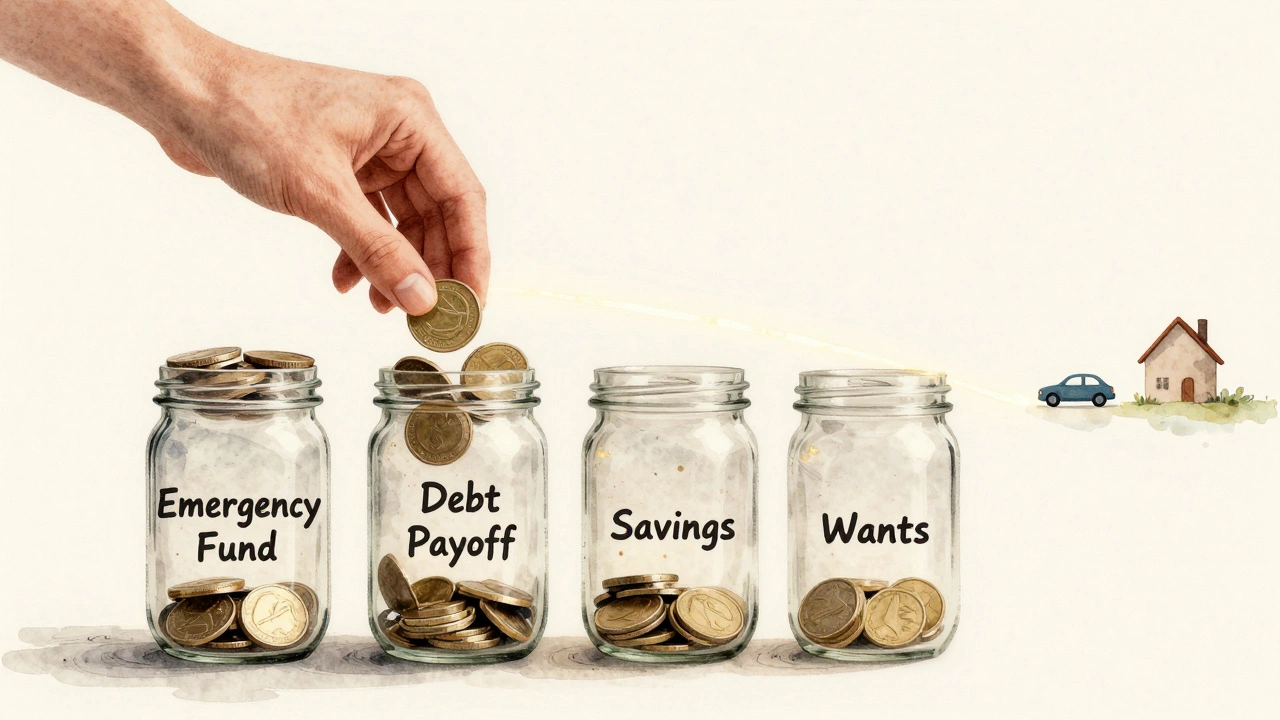
Build a spending plan that fits your life
Now you know what you spend, what matters, and what you want to achieve. Time to build your plan. Start with your income-after tax. Then assign every dollar a job. This isn’t the 50/30/20 rule you see online. That’s a suggestion, not a rule. Your budget should match your reality. If you live in Sydney and pay $1,600 rent, you won’t have $1,000 left for “wants.” That’s fine. Adjust. Use the envelope system if you like cash. Use a digital budgeting app if you prefer automation. The key is this: your expenses must be less than your income. Every month. No exceptions. If you’re spending more than you earn, you’re not budgeting-you’re borrowing from the future. And that always ends badly.
Automate the boring stuff
The most successful budgeters aren’t the ones with the most willpower. They’re the ones who made their money work for them without thinking. Set up automatic transfers the day after you get paid. Move money straight into savings, debt payments, and investment accounts before you even see it. If you get paid on the 1st and 15th, schedule transfers for the 2nd and 16th. Even $50 a week adds up to $2,600 a year. Automating savings removes temptation. It turns saving from a choice into a habit. You don’t need to be rich to do this. You just need to be consistent. Most people think they need to save 20% of income. That’s not true. Save 5%. Save 10%. Just make it automatic. The rest will follow.

Review and adjust every month
Your budget isn’t a one-time task. It’s a living document. Life changes. Your rent goes up. You get a raise. Your kid needs braces. Your car breaks down. Your budget has to adapt. Set a recurring calendar reminder: every first Sunday of the month, spend 20 minutes reviewing what happened. Did you overspend on dining out? Did you save more than expected? Did an unexpected bill hit? Adjust next month’s plan. Don’t beat yourself up. Budgeting isn’t about perfection-it’s about progress. If you miss a goal one month, ask: “What changed?” Not, “Why am I so bad at this?” The best budgeters aren’t flawless. They’re resilient.
Build a buffer for surprises
Here’s the secret most people miss: good budgeting isn’t just about controlling spending. It’s about preparing for chaos. You’ll get sick. Your washing machine will die. Your boss might cut your hours. You need a buffer. Start small. Aim for $500. Then $1,000. Then $2,000. Keep it in a separate savings account you can’t touch unless it’s a real emergency. No, your holiday to Byron Bay doesn’t count. Neither does replacing your phone because you dropped it. But if your car needs a $1,200 repair? That’s the buffer’s job. Having this cushion means you don’t have to dip into credit cards or borrow from family. It gives you breathing room. And that’s worth more than any fancy budgeting app.
Good budgeting doesn’t require genius. It doesn’t need a six-figure salary. It just needs consistency, honesty, and a little patience. The people who get ahead aren’t the ones who never spend. They’re the ones who know exactly where their money goes-and choose where it matters most.