

Home Insurance Deductible Break-Even Calculator
Current Policy (Low Deductible)
Proposed Policy (High Deductible)
Analysis Results
Imagine you’ve just saved up enough to finally fix that leaky roof. You call the contractor, get the quote, and then remember: you have home insurance. You file the claim, breathe a sigh of relief, and then see the bill from your insurer. They’re asking you to pay $2,500 before they cover the rest. Suddenly, that “savings” on your monthly premium doesn’t feel like savings at all. It feels like a trap.
This is the exact dilemma facing homeowners today. A $2,500 deductible is becoming the new standard in many markets, pushed by insurers trying to offset rising repair costs. But is it actually good for you? The short answer is: it depends entirely on your bank account, your risk tolerance, and how often you expect to make a claim. For some, it’s a smart way to lower monthly bills. For others, it’s a financial disaster waiting to happen.
How a Home Insurance Deductible Actually Works
To understand if $2,500 is right for you, we first need to strip away the jargon. Your deductible is the amount of money you agree to pay out of pocket toward a covered loss before your insurance company pays anything. Think of it as your skin in the game. If you choose a higher deductible, your monthly premium (the bill you pay every month) goes down. If you choose a lower deductible, your premium goes up.
It’s a simple trade-off. You are essentially betting on yourself. Are you betting that you won’t have a major disaster this year? If yes, a high deductible saves you cash monthly. Are you worried about a sudden fire or storm? Then a low deductible protects your wallet when things go wrong.
| Deductible Amount | Estimated Monthly Premium | Annual Premium Cost | Risk Profile |
|---|---|---|---|
| $500 | $180 | $2,160 | Low Risk / High Protection |
| $1,000 | $150 | $1,800 | Moderate Risk |
| $2,500 | $110 | $1,320 | High Savings / High Out-of-Pocket |
| $5,000 | $90 | $1,080 | Maximum Savings / Maximum Risk |
In this hypothetical scenario, jumping from a $500 deductible to a $2,500 deductible saves you $840 a year. That sounds great until you realize that if you have a single claim, you’ll pay $2,000 more than you would have with the lower deductible. You’d need to go nearly three years without a claim to break even on that specific price difference. And that’s assuming premiums don’t rise due to inflation or regional risks.
The Case for a $2,500 Deductible
There are valid reasons why a homeowner might choose a $2,500 deductible. In fact, for certain types of households, it makes perfect financial sense.
You have an emergency fund. This is the non-negotiable requirement. If you have $2,500 sitting in a high-yield savings account that you can access instantly, a higher deductible is a no-brainer. You are effectively self-insuring for small-to-medium claims. Instead of paying the insurance company extra every month to handle minor issues, you keep that money in your own pocket, earning interest, ready for when you actually need it.
You live in a low-risk area. If you live in a suburb with no history of flooding, hurricanes, or severe hail storms, your likelihood of making a large claim is statistically lower. Why pay for protection you probably won’t use? Insurers know this, which is why they offer steep discounts for higher deductibles in stable regions.
You want to avoid "nuisance claims." Many people file claims for minor damages-like a fallen tree branch breaking a window or a small water leak. These claims can sometimes raise your rates or lead to policy cancellation. With a $2,500 deductible, you’re less likely to bother filing for a $1,500 repair. You just fix it yourself. This keeps your claims history clean, which helps maintain lower long-term rates.
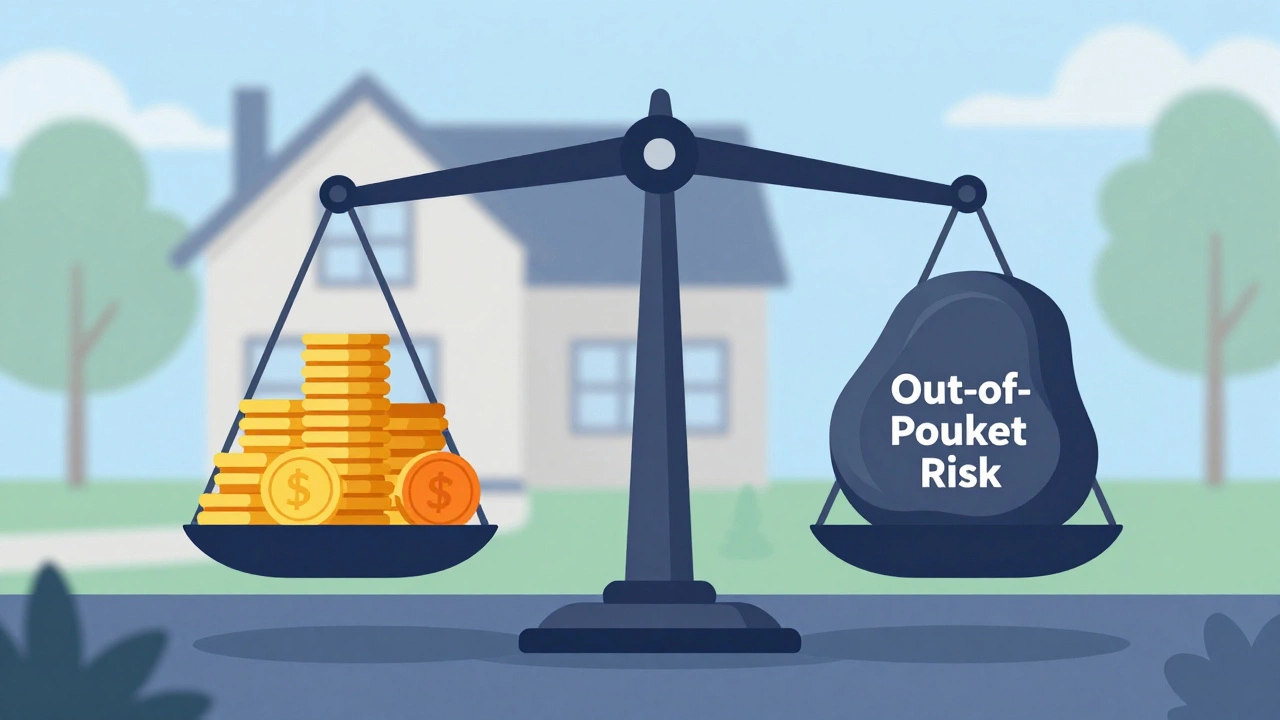
The Hidden Dangers of High Deductibles
However, the math gets messy fast if you don’t look at the whole picture. Here is where the $2,500 deductible can bite you.
The "Break-Even" Point is Farther Away Than You Think. Let’s say your premium drops by $70 a month ($840 a year) by choosing the $2,500 deductible over a $500 one. To save that $840, you must go an entire year without a claim. If you have a claim in year two, you pay the $2,500 out of pocket. Compared to the $500 deductible option, you are now $2,000 worse off. It takes multiple claim-free years to truly "win" with a high deductible.
Catastrophic Events Don’t Care About Your Budget. A deductible applies per incident. If a fire destroys half your kitchen, the repair cost might be $50,000. With a $2,500 deductible, you pay $2,500. With a $500 deductible, you pay $500. That $2,000 difference might seem small compared to $50,000, but what if the repair cost is only $3,000? With a $2,500 deductible, you pay almost everything. The insurance company pays $500. You’ve lost the benefit of having insurance for that event entirely. High deductibles shift the burden of medium-sized disasters onto you.
Natural Disaster Deductibles Are Different. This is the most critical trap. In many coastal or hurricane-prone states, your standard $2,500 deductible only applies to wind or rain damage caused by named storms. For those events, insurers often switch to a percentage deductible. If your home is valued at $300,000 and your hurricane deductible is 2%, you owe $6,000-not $2,500. Always check if your policy has separate, higher deductibles for specific natural disasters.
Who Should Avoid a $2,500 Deductible?
Not everyone is built for this strategy. You should stick to a lower deductible (like $500 or $1,000) if:
- You live paycheck to paycheck. If a $2,500 bill would force you into credit card debt or miss other essential payments, do not take the risk. Insurance is for catastrophic protection, not monthly budgeting hacks.
- You have an older home. Older homes are more prone to unexpected failures: aging pipes burst, old roofs collapse, outdated electrical systems spark fires. The frequency of claims is higher, meaning you’ll hit that deductible more often.
- You live in a high-risk zone. If you’re in a wildfire corridor, floodplain, or tornado alley, the probability of a claim is significantly higher. The math favors lower deductibles because the likelihood of needing the payout increases.
- You lack liquidity. Even if you have assets (like a house or retirement accounts), you can’t eat equity. If you don’t have cash readily available, a high deductible leaves you stranded when disaster strikes.

Strategic Ways to Manage Your Deductible
If you decide a $2,500 deductible is too risky but you still want to lower your premium, there are middle-ground strategies.
Consider a $1,000 Deductible. This is often the sweet spot. It lowers your premium enough to make a dent in your annual costs, but it’s low enough that most people can absorb it in an emergency without financial ruin. It balances monthly savings with reasonable out-of-pocket risk.
Bundle Your Policies. Instead of raising your deductible to save money, try bundling your home and auto insurance with the same provider. Bundles often offer 10-25% discounts, which can achieve similar savings to a higher deductible without increasing your risk exposure.
Improve Your Home’s Resilience. Some insurers offer discounts for impact-resistant roofs, smoke detectors, or security systems. These improvements lower your risk profile, allowing you to keep a moderate deductible while still reducing your premium.
Review Annually. Your financial situation changes. If you build up a robust emergency fund, you might bump your deductible up later. If you take on a mortgage or have a child, you might lower it. Treat your insurance policy as a living document, not a set-it-and-forget-it contract.
Calculating Your Personal Break-Even Point
Before you sign anything, do this quick calculation. Take the annual difference in premiums between the $500 and $2,500 deductible options. Divide that number by the difference in deductible amounts ($2,000). This tells you how many years of claim-free living you need to justify the higher deductible.
For example: If the $2,500 deductible saves you $600 a year, divide $600 by $2,000. You get 0.3. This means you save 30% of the deductible gap each year. It will take roughly 3.3 years of no claims to recoup the extra $2,000 you’d have to pay out of pocket in a claim. If you plan to move houses in two years, the high deductible is a bad deal. If you plan to stay for ten years, it’s a good deal.
Ultimately, a $2,500 deductible isn’t inherently "good" or "bad." It’s a financial tool. Used correctly by someone with savings and low risk, it builds wealth. Used incorrectly by someone stretched thin, it creates vulnerability. Know your numbers, know your risk, and choose the path that lets you sleep at night.
Does a higher deductible always mean a lower premium?
In almost all cases, yes. Insurers view a higher deductible as you taking on more risk, so they charge you less for the coverage. However, the discount varies by carrier and region. Some may offer a flat 10% reduction, while others might drop your rate by 20% or more. Always request a quote comparison to see the exact savings.
What happens if my claim is less than my deductible?
If the total cost of your covered loss is less than your deductible, you pay the entire amount, and the insurance company pays nothing. For example, if you have a $2,500 deductible and a pipe bursts causing $1,800 in damage, you pay $1,800. It is generally not worth filing a claim in this scenario, as it could still raise your future premiums.
Can I change my deductible after I buy a policy?
Yes, you can usually change your deductible at any time, but the change typically takes effect at the start of your next billing cycle. It does not apply retroactively to claims already filed. Keep in mind that lowering your deductible mid-policy will increase your upcoming premium payments.
Do deductibles apply to every type of damage?
Most standard perils (fire, theft, vandalism) use your standard deductible. However, many policies have separate, often higher, deductibles for specific events like earthquakes, floods, or hurricanes. Flood and earthquake insurance are usually separate policies with their own deductibles. Always read the "declarations page" of your policy to see these distinctions.
Is a percentage-based deductible better than a fixed dollar amount?
Percentage-based deductibles are common for wind/hail damage in high-risk areas. They are calculated based on the insured value of your home. For a $400,000 home with a 2% deductible, you owe $8,000. This can be much higher than a fixed $2,500 deductible. Fixed deductibles are generally more predictable and safer for budgeting, unless you are required to carry a percentage deductible due to local regulations or risk profiles.