

Debt Relief Comparison Calculator
Realistic Debt Relief Options
This calculator shows what actually happens with different debt relief methods based on your situation. Remember: there's no government program called "national debt relief."
Your Debt Details
What's in Your Debt?
Debt Relief Options
Your Results
When you’re drowning in credit card bills, medical debt, or payday loans, a headline like national debt relief sounds like a lifeline. But is it real-or just another flashy ad promising to wipe your debt clean with a single phone call? The truth isn’t as simple as yes or no. Some programs help. Others are scams. And most people don’t realize the difference until it’s too late.
What national debt relief actually means
The term national debt relief is often used by companies to make their services sound official, like something the government runs. But there’s no such thing as a federal program called "National Debt Relief" that automatically forgives your personal debt. The U.S. government doesn’t pay off your credit cards. Australia doesn’t erase your student loans. No country has a public system that wipes out private debt for the average person.
What these companies are really selling is debt settlement-a process where they negotiate with your creditors to accept less than what you owe. It’s legal. It’s been around for decades. But it’s not free, it’s not instant, and it’s not guaranteed.
Think of it like this: you owe $15,000 on a credit card. A debt relief company tells you they can get the bank to accept $7,500 instead. That sounds great-until you learn you’ll pay them $3,000 in fees, your credit score drops 100+ points, and you’ll owe taxes on the $7,500 they "forgave."
How debt settlement really works (and why it hurts)
Here’s the step-by-step reality:
- You stop paying your creditors. This triggers late fees, penalties, and collection calls.
- You deposit money into a savings account controlled by the debt relief company.
- After 6-24 months, they try to negotiate with your creditors using the accumulated funds.
- If they succeed, you pay the company 15-25% of the settled amount as a fee.
- You get a 1099-C form from the IRS (in the U.S.) or an equivalent tax notice in Australia, meaning the forgiven debt is treated as income.
This isn’t magic. It’s a gamble. And most people don’t make it through. A 2023 study by the Consumer Financial Protection Bureau found that nearly 40% of people who enrolled in debt settlement programs never completed them. Their credit was wrecked, their savings were gone, and their debt was still there.
What actually works instead
If you’re serious about getting out of debt, there are better paths-ones that don’t destroy your credit or leave you with a tax bill.
Debt consolidation loan
This is when you take out a single personal loan to pay off multiple high-interest debts. If you qualify for a lower interest rate, you’ll pay less overall and simplify your payments. In Australia, credit unions and online lenders like Upstart and Jacaranda Finance offer unsecured consolidation loans starting at 7.9% APR for people with fair credit. That’s a huge drop from 20%+ on credit cards.
Pros: Fixed payments, lower interest, faster payoff. Cons: You need decent credit. If you keep using your old cards, you’ll be back in debt faster.
Credit counseling and debt management plan (DMP)
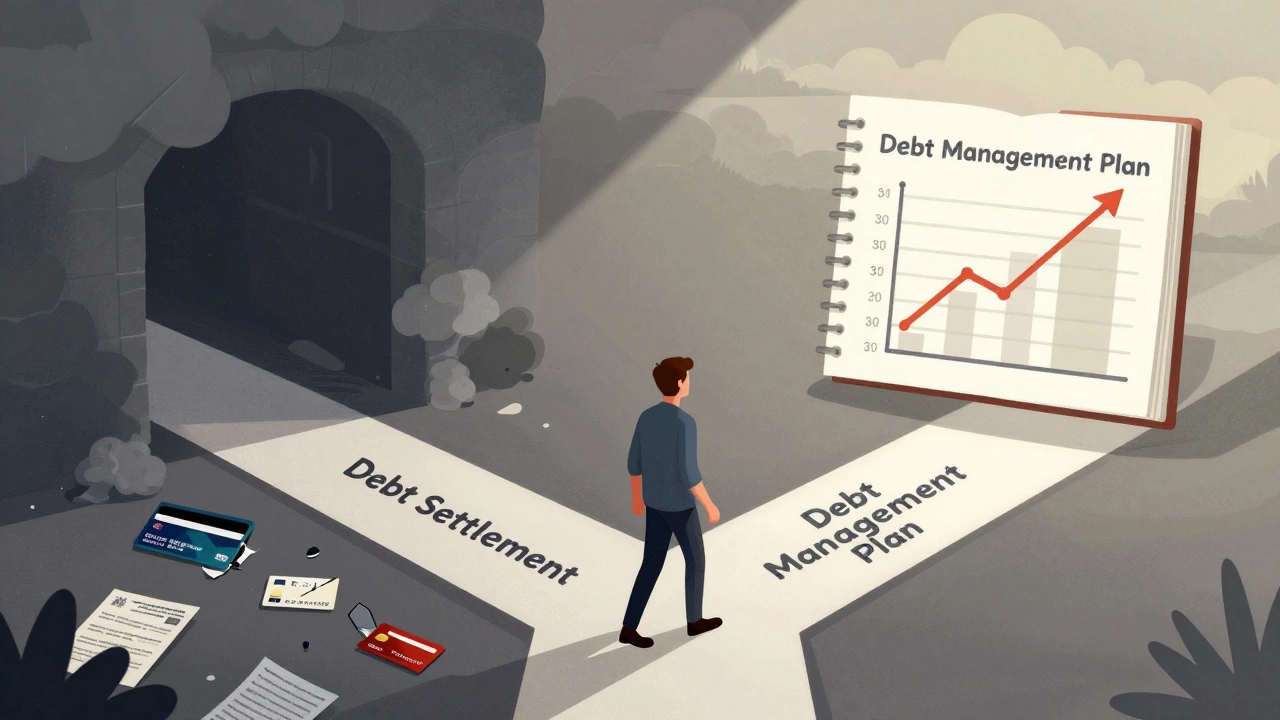
Nonprofit credit counseling agencies (like Financial Counseling Australia or MoneySmart’s accredited partners) can help you set up a Debt Management Plan. They contact your creditors and ask for reduced interest rates or waived fees. You make one monthly payment to them, and they distribute it to your creditors.
Most creditors agree to this because they’d rather get paid something than nothing. Interest rates often drop to 5-10%. The plan usually lasts 3-5 years. Your credit report will show you’re on a DMP, but it doesn’t carry the same stigma as settlement.
Bankruptcy
It’s not glamorous, but for some, it’s the cleanest solution. In Australia, you can file for bankruptcy under the Bankruptcy Act 1966. It wipes out unsecured debts like credit cards and medical bills. You’ll lose access to credit for three years, and your name goes on a public register. But you can keep your car and home if they’re below a certain value. It’s not a free pass-it’s a reset button.
Red flags that mean you’re being scammed
Watch out for these signs:
- They guarantee to eliminate your debt
- They ask for upfront fees before doing any work (illegal in Australia under the National Consumer Credit Protection Act)
- They tell you to stop talking to your creditors
- They don’t tell you about tax consequences
- They use names like "National Debt Relief," "United Debt Solutions," or "Government Debt Forgiveness Program"
The Australian Competition and Consumer Commission (ACCC) has shut down dozens of these firms in the last five years. They often operate from overseas, take your money, and vanish.
Who should avoid debt relief programs entirely
Debt settlement isn’t for everyone. If you:
- Have a steady income and can afford $200-$500 a month toward debt
- Own a home or car you want to keep
- Plan to apply for a mortgage, car loan, or job that checks credit in the next 2-5 years
- Have less than $10,000 in unsecured debt
Then you’re better off with a budget, a consolidation loan, or a DIY payoff plan. The math is simpler, and your credit survives.
What to do right now
Stop Googling "national debt relief" and start taking real steps:
- Get a free credit report from Equifax or Experian. Know exactly what you owe.
- Calculate your total unsecured debt and monthly payments.
- Call your creditors. Ask for hardship programs. Many offer temporary reduced payments or interest freezes.
- Visit MoneySmart.gov.au and use their debt calculator.
- If you’re overwhelmed, book a free session with a certified financial counselor through Financial Counseling Australia. They don’t sell anything. They just help.
There’s no secret trick. No government bailout. No magic button. But there is a clear path out-especially if you start now.
Real story: Sarah’s turnaround
Sarah, 34, from Newcastle, had $22,000 in credit card debt and medical bills. She got a call from a "national debt relief" company offering to settle for $8,000. They wanted $5,000 upfront. She walked away.
Instead, she went to a nonprofit counselor. They got her interest rates cut from 24% to 9%. She started paying $600 a month. Two years later, she was debt-free. Her credit score went from 520 to 710. She bought a used car last month. No drama. No tax bill. Just hard work.
That’s the real national debt relief: not a company promising the moon, but a person who refused to be fooled and took control.
Is national debt relief a government program?
No. There is no official government program called "national debt relief" that forgives personal debt. The term is used by private companies to sound legitimate. The Australian government offers free financial counseling through accredited agencies, but it doesn’t pay off your debts.
Can debt relief companies really reduce my debt by 50% or more?
Sometimes-but only after you’ve stopped paying your bills for months, damaged your credit, and paid them thousands in fees. The actual settlement amount depends on your creditor’s willingness to negotiate, not the company’s promises. Many people never reach settlement at all.
Will debt relief hurt my credit score?
Yes, badly. Missing payments, settling accounts for less than owed, and defaulting all show up on your credit report as negative marks. Your score can drop 100-150 points and take 7-10 years to fully recover. Debt management plans hurt less, but still appear on your report.
Do I have to pay taxes on forgiven debt?
In Australia, forgiven debt is generally not treated as taxable income like it is in the U.S. However, if you’re an Australian citizen living overseas or have income from U.S. sources, tax implications may apply. Always consult a tax professional before signing any debt settlement agreement.
What’s the cheapest way to get out of debt?
The cheapest way is to pay it off yourself using a budget and a debt snowball or avalanche method. If you need help, a free debt management plan through a nonprofit counselor is the next best option. Avoid companies that charge upfront fees-those are the most expensive paths.
Next steps if you’re drowning in debt
Start with this:
- Write down every debt: creditor, balance, interest rate, minimum payment.
- Call each creditor. Ask: "Do you have a hardship program?" Many do.
- Go to MoneySmart.gov.au and use their free debt calculator.
- Find a free financial counselor through Financial Counseling Australia (1800 007 007).
- Stop signing up for anything that asks for money before they do work.
You don’t need a miracle. You need a plan-and the courage to follow it. The companies selling "national debt relief" don’t want you to know that. But now you do.