

Portfolio Allocation Calculator for Age 55
Your Profile
Recommended Strategy
Turning 55 feels like standing on the edge of a cliff. You can see the finish line-retirement-but you haven’t quite reached it yet. For most people, this is the decade that makes or breaks their financial future. The old rule of thumb was to play it safe and put everything in cash. That advice is dead. With inflation eroding purchasing power and life expectancy rising, sitting on cash is actually the riskiest move you can make.
If you are 55 today, you likely have about 10 to 15 years until you stop working full-time. But here is the catch: once you retire, your money needs to last for another 20 to 30 years. That means your investment strategy cannot be purely conservative, nor can it be aggressively risky. You need a balance that protects what you have while still growing enough to keep up with living costs.
Is it too late to start investing at 55?
No, it is not too late, but the strategy changes. At 55, you shift from aggressive accumulation to balanced growth and preservation. You have roughly 10-15 years to compound returns before retirement, which is significant time if invested wisely in diversified assets like index funds and dividend stocks.
The "Accumulation vs. Preservation" Dilemma
At 55, your primary job-to-be-done is managing the transition between two distinct phases: building wealth and protecting it. This is often called the "glide path." In your 30s and 40s, you could afford to lose 20% of your portfolio because you had decades to recover. Now, a major market crash five years from now would hit you right as you’re preparing to withdraw income. That timing is dangerous.
However, going 100% into low-risk bonds or savings accounts is equally dangerous. Why? Because inflation acts as a silent thief. If your investments earn 3% but inflation runs at 4%, you are losing real purchasing power every year. Your goal should be to beat inflation by a small margin while minimizing volatility. This requires a mix of asset classes that don't all move in the same direction.
You need to ask yourself: How much do I already have saved? If you are on track for retirement, preservation becomes more important. If you are behind, you may need to take slightly higher risks to close the gap. There is no one-size-fits-all answer, but there is a framework that works for most mid-career investors.
Core Asset Classes for the Mid-Career Investor
Let’s break down the specific vehicles you should consider. These aren't just random picks; they serve specific roles in a portfolio designed for someone who will need liquidity soon.
Broad Market Index Funds are passive investment vehicles that track a specific market index, such as the S&P 500 or ASX 200, providing instant diversification across hundreds of companies. Even at 55, equities (stocks) remain essential. They provide the growth engine. Without them, your portfolio stagnates. However, you shouldn't pick individual tech stocks hoping for a moonshot. Instead, use low-cost index funds. They spread your risk across the entire economy. If one company fails, thousands of others carry the weight. Historically, global equity markets have returned about 7-9% annually over long periods, though past performance never guarantees future results.
Dividend Aristocrats are companies with a long history of consistently paying and increasing dividends to shareholders, typically for at least 25 consecutive years. As you approach retirement, cash flow becomes king. Dividend-paying stocks offer a dual benefit: price appreciation and regular income. Companies that pay dividends tend to be more mature and stable than high-growth startups. They provide a psychological buffer during market downturns because you still receive checks even if the stock price drops. Look for sectors like consumer staples, healthcare, and utilities. These industries perform well regardless of the economic cycle.
Government Bonds are debt securities issued by national governments to finance public spending, offering fixed interest payments and return of principal at maturity. Bonds are the shock absorbers in your portfolio. When stocks fall, bonds often rise or stay stable. This negative correlation reduces overall portfolio volatility. At 55, you should allocate a meaningful portion of your portfolio to high-quality government bonds. They preserve capital and provide predictable income. In Australia, Commonwealth Government Securities (CGS) are considered virtually risk-free regarding default.
Real Estate Investment Trusts (REITs) are companies that own, operate, or finance income-producing real estate, allowing investors to earn dividends from real estate portfolios without having to buy property directly. Many people think owning physical rental property is the only way to invest in real estate. But managing tenants and toilets is a part-time job you probably don't want at 55. REITs let you invest in commercial properties, shopping centers, and data centers through the stock market. They are required by law to distribute most of their taxable income to shareholders, making them attractive for yield-focused investors.
Building a Balanced Portfolio: The Numbers Game
Knowing what to buy is half the battle. Knowing how much to buy is the other half. Financial advisors often use simple rules of thumb to determine asset allocation. One common heuristic is the "110 minus age" rule. If you are 55, subtract 55 from 110. That gives you 55%. This suggests you should hold 55% of your portfolio in growth assets (like stocks and REITs) and 45% in defensive assets (like bonds and cash).
This is a starting point, not a commandment. If you have a strong pension or superannuation guarantee backing you up, you might lean more toward growth. If you rely entirely on your personal investments, you might lean more toward safety. The key is to avoid extremes. Don't go 100% stocks unless you have a very high risk tolerance and a large safety net. Don't go 100% bonds unless you are terrified of any loss and have other sources of income.
| Risk Profile | Growth Assets (Stocks/REITs) | Defensive Assets (Bonds/Cash) | Primary Goal |
|---|---|---|---|
| Conservative | 30% | 70% | Capital Preservation |
| Moderate | 55% | 45% | Balanced Growth & Income |
| Growth-Oriented | 75% | 25% | Maximizing Returns |
Notice that even the "Growth-Oriented" profile keeps 25% in defensive assets. That buffer exists to protect you from sequence of returns risk-the danger that a market crash happens right when you start withdrawing money. That early loss can devastate a portfolio's longevity.
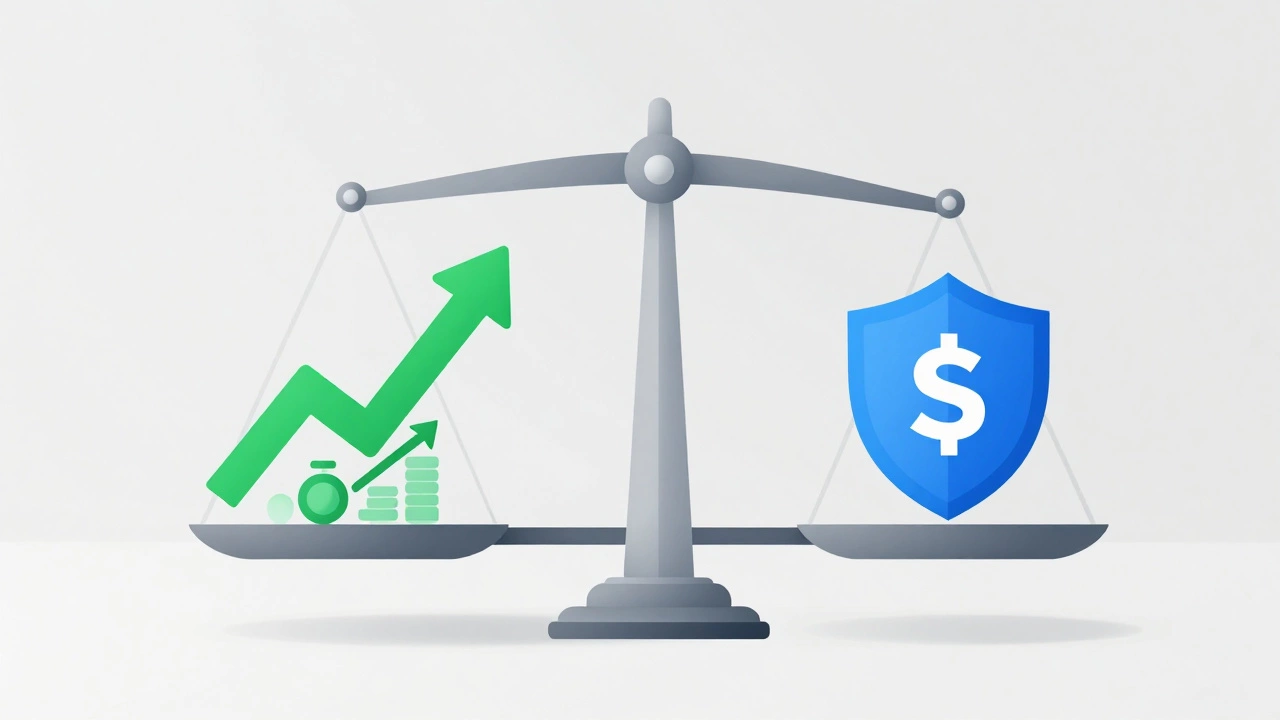
The Power of Dollar-Cost Averaging
You might be looking at the market and thinking, "It's too high to buy now." Or perhaps you're worried about an impending recession. Timing the market is impossible, even for professionals. What you can control is your entry strategy. Dollar-cost averaging is your best friend at this stage.
Instead of dumping a lump sum into the market all at once, invest a fixed amount regularly-say, $1,000 every month. When prices are high, you buy fewer units. When prices drop, you buy more units. Over time, this smooths out your average cost per share. It removes the emotional stress of trying to predict short-term market movements. Consistency beats intensity. Regular contributions force discipline and ensure you are always participating in the market's upside.
Tax Efficiency and Account Structure
Where you hold your investments matters just as much as what you hold. Tax drag can eat away at your compounding gains significantly over 10-15 years. In many jurisdictions, including Australia, retirement accounts like Superannuation offer tax advantages that standard brokerage accounts do not.
In Australia, contributions to Superannuation are taxed at a concessional rate of 15%, whereas your marginal income tax rate might be 37% or 45%. Additionally, investment earnings within Super are taxed at only 15%, and withdrawals in retirement are often tax-free. If you are not maximizing your Super contributions, you are leaving free money on the table. Consider salary sacrificing-paying pre-tax income into your Super-to boost your balance immediately while reducing your current tax bill.
For investments held outside of Super, look for tax-efficient assets. Bonds and dividend stocks generate taxable income every year. Index funds, which rarely trade internally, generate fewer capital gains events. Holding these assets in tax-advantaged accounts shields you from annual tax bills, allowing more of your money to compound.

Avoiding Common Pitfalls at 55
Experience brings wisdom, but it also brings biases. Here are three traps that catch older investors:
- The Home Bias: Investing only in local companies because they feel familiar. If you live in Sydney, you might overweight Australian banks and miners. This exposes you to single-country risk. Global diversification spreads your risk across different economies and currencies. If the Australian dollar weakens, your international holdings gain value in local terms.
- Chasing Yield: Seeing a fund advertise an 8% dividend yield and buying it without checking the sustainability. High yields often signal trouble. If a company pays out more than it earns, it will eventually cut the dividend. Focus on payout ratios-the percentage of earnings paid as dividends. A ratio under 60-70% is generally safer.
- Neglecting Liquidity: Locking all your money into illiquid assets like private equity or physical property. You need access to your cash for emergencies, medical bills, or opportunities. Keep a cash reserve equivalent to 6-12 months of living expenses in a high-interest savings account. This prevents you from being forced to sell investments at a loss during a crisis.
Rebalancing: Your Secret Weapon
Set it and forget it doesn't work for investing. Markets move. If your stock portfolio has a great year, it might grow from 55% of your portfolio to 70%. You are now taking more risk than you intended. Rebalancing involves selling some of the winners and buying more of the losers to get back to your target allocation.
This forces you to sell high and buy low-a habit that is psychologically difficult but mathematically profitable. Do this once a year, or whenever your asset allocation drifts by more than 5%. It keeps your risk level constant and disciplines your behavior.
Final Thoughts on the Decade Ahead
Your 50s are the bridge between your working life and your retirement life. The investments you make now define the quality of your later years. It’s not about getting rich quick; it’s about staying rich enough to maintain your lifestyle. By focusing on diversification, tax efficiency, and disciplined contribution, you build a portfolio that can withstand storms and weather the heat. Start adjusting your glide path today. Your future self will thank you.
Should I pay off my mortgage or invest at 55?
This depends on your mortgage interest rate versus expected investment returns. If your mortgage rate is high (e.g., above 6%), paying it off offers a guaranteed, risk-free return equal to the interest saved. If your rate is low, investing may offer higher long-term growth. However, eliminating debt provides significant psychological relief and reduces monthly cash flow obligations in retirement, which is valuable for peace of mind.
How much should I have saved by age 55?
A common benchmark is having 7 to 10 times your annual salary saved by age 55. This helps ensure you have enough capital to replace your income during retirement. For example, if you earn $100,000 a year, aiming for $700,000 to $1,000,000 in total retirement savings is a reasonable target. Adjust this based on your expected retirement lifestyle and other income sources like pensions.
Are cryptocurrencies suitable for a 55-year-old investor?
Cryptocurrencies are highly volatile and speculative. While they offer potential for high returns, they also carry significant risk of total loss. At 55, capital preservation is crucial. If you choose to include crypto, limit it to a very small portion of your portfolio (e.g., 1-5%) that you can afford to lose completely. It should never form the core of your retirement strategy.
What is the best type of bond for a conservative portfolio?
Government bonds, such as Australian Commonwealth Government Securities (CGS) or US Treasury Bonds, are considered the safest bonds. They have negligible default risk. Corporate bonds offer higher yields but come with credit risk. For a conservative portfolio near retirement, prioritize high-grade government bonds or investment-grade corporate bond funds to minimize volatility and ensure capital stability.
How does inflation affect my retirement savings?
Inflation reduces the purchasing power of your money over time. If inflation averages 3% per year, your money will lose half its value in about 24 years. To combat this, your investments must generate returns that exceed inflation. Pure cash savings will lose value. Equities, real estate, and inflation-linked bonds are better tools for preserving purchasing power over a 20-30 year retirement horizon.